
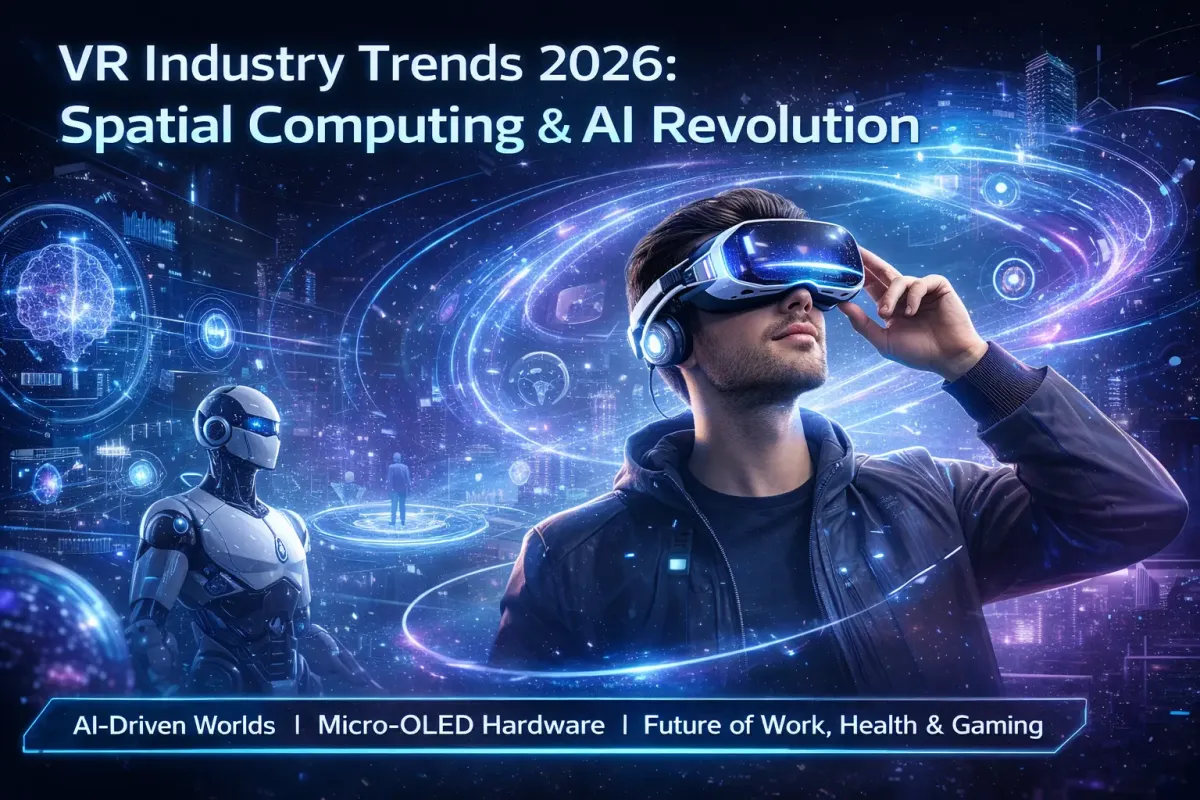
By 2026, Virtual Reality (VR) has successfully shed its image as a clunky peripheral for gamers. It has evolved into Spatial Computing a seamless integration of digital content into our physical surroundings. This transition is not merely semantic, it represents a fundamental shift in how humans interact with information, machines, and each other.
In this analysis, we will break down the primary drivers of the VR industry in 2026, ranging from hardware breakthroughs to the profound impact of Generative AI.
1. Hardware: The "Invisible" Headset
The most significant trend in 2026 is the miniaturization and ergonomic perfection of VR hardware. The "toaster on your face" era is over.
1.1. Micro-OLED and 12K Resolution
The standard for mid-to-high-end headsets in 2026 is Micro-OLED technology. These displays offer a pixel density that finally matches the human eye's foveal resolution.
- Resolution: 8K to 12K per eye is now standard, eliminating the "screen-door effect" entirely.
- Brightness: With peak brightness reaching 5,000 nits, HDR content in VR looks as vivid as looking out a window.
1.2. Pancake Lenses 3.0
The third generation of Pancake Lenses has allowed manufacturers to reduce the optical stack's depth to less than 20mm. This makes the headsets look more like high-tech ski goggles or oversized sunglasses.
1.3. Silicon Photonics and Neural Processing Units (NPUs)
Internal chipsets, such as the Snapdragon XR3 Gen 2 or Apple’s R-series chips, now feature dedicated NPUs. These chips handle eye-tracking, hand-tracking, and environmental mapping locally with sub-10ms latency, leaving the main CPU/GPU free to render complex 3D environments.
2. The Generative AI Integration
If hardware is the body, AI is the soul of VR in 2026. The marriage of Generative AI and spatial environments has solved the content scarcity problem.
2.1. Real-time World Building
User-generated content (UGC) has exploded. Platforms now allow users to "speak" worlds into existence. By saying, "Create a 1920s jazz club in New Orleans with rainy windows and interactive instruments," the AI generates a fully collision-mapped 3D environment in seconds using Neural Radiance Fields (NeRFs) and Gaussian Splatting.
2.2. LLM-Powered NPCs
Non-Player Characters (NPCs) are no longer static. They are powered by specialized on-device Large Language Models. These characters have:
- Contextual Awareness: They know what you are wearing or holding in the VR space.
- Persistent Memory: They remember your previous interactions, creating a deep sense of immersion in RPGs and training simulations.
3. Enterprise: The Virtual Headquarters (VHQ)
In 2026, "working from home" has been replaced by "working from the VHQ."
3.1. Digital Twins and Industrial Metaverses
Factories and logistics centers now operate via Digital Twins. Managers can "teleport" to a 1:1 virtual replica of a factory floor in Germany while sitting in Singapore to troubleshoot a robotic arm.
- Precision: Real-time IoT data is overlaid onto the VR view, showing temperature, stress levels, and output metrics in a 3D dashboard.
3.2. Soft Skills Training
VR has become the primary tool for HR. Employees practice difficult conversations, diversity training, and leadership skills with AI avatars that can simulate a wide range of human emotions and reactions.
4. Healthcare: Beyond the Screen
VR in 2026 is a certified medical tool.
- Surgical Planning: Surgeons utilize patient-specific 3D models generated from MRIs to "rehearse" complex surgeries. They can see the exact placement of tumors and blood vessels before making a single incision.
- Pain Management: "Digital Sedation" is used in clinics to reduce the need for pharmaceutical painkillers. Immersive VR environments distract the brain's pain receptors during procedures like wound care or physical therapy.
- Mental Health: VR Exposure Therapy (VRET) is the gold standard for treating PTSD and anxiety disorders, providing a safe, controlled environment for patients to confront triggers.
5. Education: The Death of the Textbook
By 2026, the global education system has integrated "Spatial Lessons."
- Historical Immersion: Students don't read about the French Revolution, they stand in the crowd.
- Abstract Visualization: In chemistry, students can shrink to the size of an atom to manipulate molecular bonds, making abstract concepts tangible.
- Global Classrooms: A student in a rural village can sit in the same "virtual" lecture hall as a student at Harvard, democratizing high-quality education.
6. Connectivity: 5G, 6G, and Cloud XR
The debate between "standalone" and "PC-VR" has vanished.
6.1. Edge Computing
Most of the heavy rendering in 2026 happens at the Edge. High-speed 5G and nascent 6G networks allow headsets to offload graphics processing to nearby servers. This keeps the headset light and cool while delivering graphics that rival a high-end gaming PC.
6.2. Wi-Fi 7
With Wi-Fi 7, the connection between the headset and local devices (like a laptop or phone) is virtually lag-free, allowing the headset to act as a multi-monitor replacement for traditional workstations.
7. The Social Fabric: Codec Avatars
The "uncanny valley" has finally been crossed. In 2026, social VR uses photorealistic Codec Avatars.
- Using a quick 30-second scan from a smartphone, users create a 3D avatar that looks exactly like them.
- Eye and Face Tracking: The avatar mimics every blink, smirk, and eyebrow raise in real-time, making virtual eye contact feel genuine for the first time.
8. Ethical Challenges and Data Sovereignty
As VR becomes integral to life, new challenges arise.
- Spatial Privacy: Headsets collect "biometric footprints" how you walk, move your eyes, and react to stimuli. In 2026, there is a massive push for Decentralized Identity to ensure users own their spatial data.
- The Reality Gap: Psychologists are now studying the long-term effects of "Reality Blur," where heavy users struggle to distinguish between memories formed in VR and those from the physical world.
9. Conclusion: A New Human Experience
The VR industry in 2026 is no longer about "escapism." It is about enhancement. Whether it is making a surgeon more precise, a student more engaged, or a remote worker more connected, VR has become the primary interface for the digital age.
The transition to Spatial Computing is complete. The question for businesses and individuals is no longer if they will use VR, but how they will navigate a world where the physical and digital are one.