
For decades, fitness followed a predictable, often grueling pattern: driving to a windowless building, sharing equipment with strangers, and staring at a wall while running on a treadmill. By 2026, that model is collapsing.
The Meta Quest 3 has done for fitness what the smartphone did for photography, it made it ubiquitous, personalized, and, most importantly, invisible. We are no longer "playing games" in VR, we are engaging in Spatial Athletics. This shift isn't just about fun, it’s about a scientifically-backed, AI-driven approach to human longevity and physical performance.
Chapter 1: The Hardware of Sweat – Why Quest 3 Won the Fitness War
In 2023, critics wondered if a headset could survive high-intensity interval training (HIIT). In 2026, we have the answer.
1.1. Ergo-Kinetic Design
The Quest 3’s pancake lenses and slimmed-down optic stack weren't just for aesthetics. They shifted the center of gravity closer to the user's face, reducing "neck whip" during fast movements like boxing or dodging.
- Breathability: The 2026 ecosystem of third-party "Active Straps" and facial interfaces has solved the fogging issues of the past.
- Controller-Free Freedom: Advanced AI Hand Tracking means you can now use real dumbbells or resistance bản trong while the headset tracks your reps and form without needing to hold a plastic controller.
1.2. The Mixed Reality (MR) Safety Net
The transition from VR to Mixed Reality (MR) is the single biggest factor in the fitness boom.
- Environmental Awareness: Using the Quest 3’s high fidelity passthrough, you can see your water bottle, your yoga mat, and most importantly your ceiling fan.
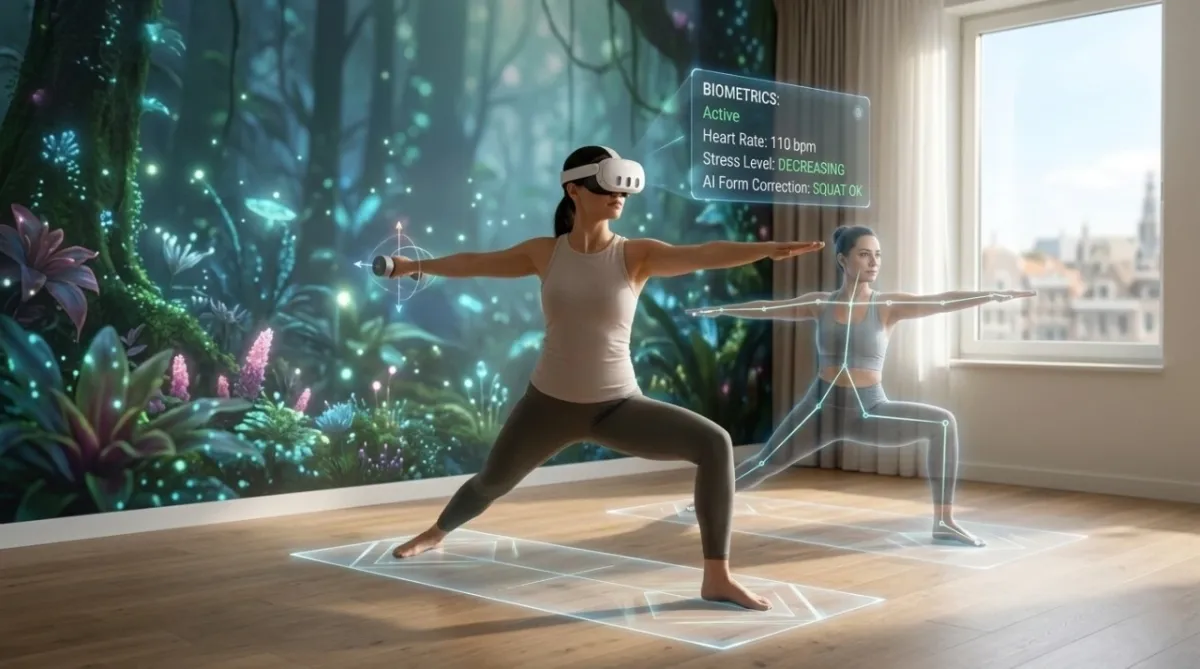
- Spatial Anchoring: Workout apps now "anchor" digital UI elements onto your real-world walls. Your heart rate is projected onto your actual door, your virtual coach stands on your actual carpet.
Chapter 2: The AI Coach – Real Time Biomechanical Analysis
The "AI" in Meta Quest 3 fitness is no longer just a pre-recorded voice. It is a sophisticated biomechanical analyzer.
2.1. Computer Vision & Form Correction
Using the Quest 3’s downward-facing cameras and AI algorithms, fitness apps can now track your skeleton in 3D space.
- Squat Depth: The AI detects if your knees are tracking over your toes or if your back is rounding.
- Holographic Correction: If your form is off, a semi-transparent "ghost" of yourself appears in front of you, showing you exactly how to adjust your posture to prevent injury. This is AI powered injury prevention at its finest.
2.2. Dynamic Adaptive Loading
Static workout plans are a thing of the past. In 2026, the Quest 3 integrates with your Oura Ring, Whoop, or Apple Watch.
- The Workflow: If your wearable reports low recovery or poor sleep, the Quest 3's AI fitness coordinator automatically scales back your HIIT session into a restorative "Spatial Yoga" flow. It adapts the resistance and tempo in real-time based on your Heart Rate Variability (HRV).
Chapter 3: Gamification vs Performance – The "Supernatural" Effect
Apps like Supernatural and Les Mills Bodycombat were the pioneers, but the 2026 landscape is far more diverse.
3.1. Immersive Environment Psychology
Why run on a treadmill in a basement when you can jog through a photorealistic reconstruction of the Swiss Alps?
- Flow State Induction: AI generated music (via Lyria 3) syncs perfectly to your movement cadence, pushing your brain into a "flow state" where perceived exertion drops by up to $20. You work harder because your brain thinks you're playing.
- The Virtual Pacer: AI "shadow runners" based on your previous best times or your friends' data run alongside you, providing a tangible goal to chase.
3.2. Social Fitness Hubs
The "lonely gamer" is a myth. Social VR fitness clubs are the new country clubs.
- Sync-Workouts: You and three friends from different continents can meet in a virtual Dojo. You see each other's avatars, hear each other's spatial audio, and compete in real-time. This is globalized community fitness.
Chapter 4: Mental Wellness & Spatial Meditation
Fitness in 2026 isn't just about muscles, it's about the nervous system. The Quest 3 has become the ultimate tool for Spatial Wellness.
4.1. Neural Decompression
After a high-stress workday in the "Spatial Office," users transition to "Spatial Zen" modes.
- Binaural Environments: AI-generated 3D soundscapes move around you, guided by your breathing patterns (tracked by the headset's microphone).
- Visual Breathwork: Seeing your breath represented as glowing particles in the air helps users master diaphragmatic breathing, a technique used by elite athletes to lower cortisol.
Chapter 5: The Economics of the Digital Gym
The math for the Quest 3 in 2026 is simple.
- Cost Analysis: A high-end gym membership costs $150 - $300 per month. A Quest 3 is a one-time hardware investment that pays for itself in three months.
- Space Efficiency: It turns a 2 x 2 meter square of floor space into a $10,000$ square foot Olympic training center. For urban dwellers in tiny apartments, this is the only way to own a "home gym."
Conclusion: The Era of the Augmented Human
The Meta Quest 3 has successfully transitioned from a "cool gadget" to a "critical health device." By merging the power of AI driven biomechanics with the boundless possibilities of Mixed Reality, it has solved the biggest problem in fitness: Boredom.
In 2026, we don't "go to the gym." We put on our glasses and step into a world where our health is optimized by intelligence and limited only by our imagination.
Experience True 8K Virtual Reality
Stream our master-grade 8K VR porn scenes in 180° POV and ultra-realistic passthrough on DeepInSex.