
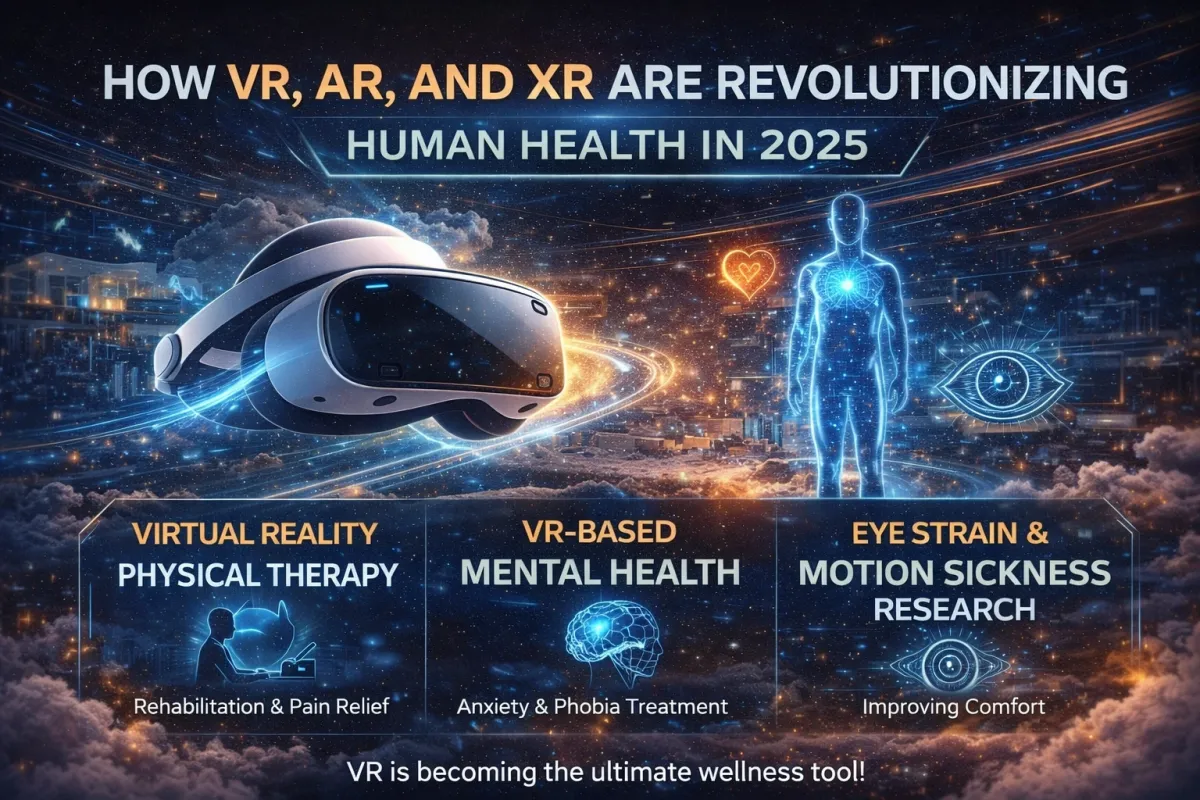
1. Introduction: From Entertainment to "Immersive Therapeutics"
In 2025, we are witnessing a profound shift. Virtual Reality is no longer just a console for gamers, it is being FDA-authorized as a medical treatment. From managing chronic lower back pain to treating PTSD in veterans, "Immersive Therapeutics" is the new frontier of medicine.
However, as we spend more time in digital worlds, questions about eye health, brain plasticity, and "VR legs" (motion sickness) have moved from Reddit forums to peer-reviewed medical journals.
2. VR as a Painkiller: The Gate Control Theory in 3D
One of the most miraculous hardware-software synergies in 2025 is VR Pain Management.
A. Distraction Therapy
When the brain is immersed in a high-fidelity 360-degree environment, it literally has less "bandwidth" to process pain signals. This is based on the Gate Control Theory of Pain.
- Post-Operative Recovery: Hospitals are now using Quest 3 and Vision Pro headsets during wound dressing or minor surgeries to reduce the need for opioids by up to 50%.
- Chronic Pain: FDA-approved platforms like AppliedVR use 56-session VR programs to teach patients diaphragmatic breathing and cognitive-behavioral skills to manage chronic pain long-term.
B. The Science of Biofeedback
Modern headsets now use their internal sensors to monitor heart rate variability (HRV) and respiration. If the system detects a spike in stress, the VR environment dynamically changes colors become cooler, and the music slows down to help the patient self-regulate.
3. Mental Health: The Virtual Couch
The integration of Generative AI and XR has created a new form of therapy: Virtual Exposure Therapy (VET).
- Phobia Treatment: Whether it's a fear of heights or public speaking, VR allows patients to face their fears in a 100% controlled, safe environment. In 2025, AI-driven NPCs can simulate a "judgmental audience" that reacts to your voice, helping you practice social interactions.
- PTSD & Combat Stress: By recreating specific environments in a therapeutic setting, veterans can process traumatic memories under the guidance of a clinician, a method that has shown a higher success rate than traditional talk therapy.
4. Physical Health: The Gamification of Fitness
Is your VR workout as good as the gym? In 2025, the answer is a resounding "Yes."
- Caloric Burn: Research shows that high-intensity VR games like Supernatural or Les Mills Bodycombat can burn as many calories as competitive tennis or swimming.
- The "Flow State": Because VR games are designed to be fun, users enter a "Flow State" where they lose track of time. This increases exercise adherence people are more likely to stick to a VR workout routine than a treadmill.
- Neuroplasticity: For stroke survivors, VR physical therapy uses "Gamified Rehabilitation" to encourage repetitive movements, helping the brain "rewire" itself to regain motor control.
5. The "Dark Side": Eye Strain, Myopia, and Brain Adaptation
We cannot talk about VR health without addressing the physical costs of wearing a screen inches from your eyes.
A. Vergence-Accommodation Conflict (VAC)
In the real world, your eyes focus and converge at the same distance. In VR, they focus on a screen at a fixed distance but converge on virtual objects miles away.
- The Symptom: This causes visual fatigue and headaches after 30-40 minutes.
- The 2025 Solution: Advanced headsets are now testing Varifocal Lenses lenses that physically move or change shape to match your gaze, potentially eliminating VAC forever.
B. The Blue Light Debate
Quest 3 and Vision Pro screens emit significant blue light. While 2025 studies show no permanent retinal damage in healthy adults, Digital Eye Strain (Asthenopia) is real.
- Dry Eyes: Because we blink 60% less while in VR, the eye surface dries out. "VR hygiene" (the 20-20-20 rule) is now a mandatory recommendation for all new users.
6. Solving VR Sickness: The "Vestibular" Challenge
Motion sickness happens when your eyes see movement, but your inner ear (vestibular system) feels nothing.
| Technology | How it Fixes Sickness | 2025 Status |
| GVS (Galvanic Vestibular Stimulation) | Small electrical pulses to the ear to simulate balance. | Experimental/High-end |
| 90Hz/120Hz Refresh Rates | Reduces the lag between head movement and display. | Standard |
| Dynamic Vignetting | Blurs the periphery during fast movement to ground the user. | Standard in Apps |
| Teleportation Locomotion | Skips the "sliding" movement that triggers nausea. | Industry Standard |
7. Children and VR: Is it Safe?
The official age for VR used to be 13+. In 2025, Meta and other manufacturers have lowered this to 10+ with parental controls.
- The Concern: Excessive VR use in children could affect depth perception development and the progression of myopia (nearsightedness).
- The Recommendation: Pediatricians suggest limiting children to 30-minute sessions and ensuring the IPD (Interpupillary Distance) is correctly adjusted to their smaller faces.
8. Conclusion: Finding the Balance
The year 2025 has proven that VR/AR/XR is one of the most powerful tools in the history of healthcare. It can distract us from pain, help us face our deepest fears, and turn a boring workout into an epic adventure.
However, like any medicine, the dose makes the poison. Proper headset calibration, frequent breaks, and a focus on high-frame-rate content are essential to maintaining your physical well-being in the digital age. As we move toward 2026, the goal of the industry is to make the technology so "invisible" and comfortable that the health risks disappear, leaving only the healing power of the virtual world.