
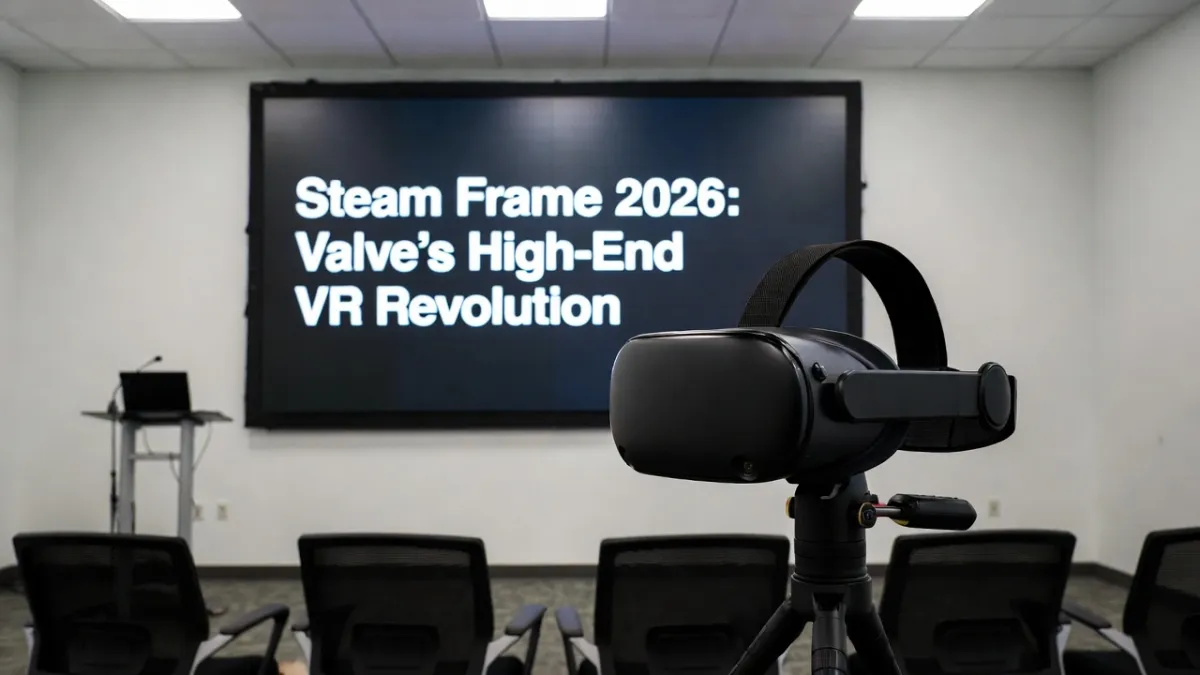
The arrival of the Valve Steam Frame in early 2026 marks the end of the "Standalone vs PCVR" debate. For years, users had to choose between the convenience of Meta’s mobile chipsets and the raw, tethered power of a gaming rig. Valve has effectively deleted that boundary.
The Steam Frame is a "Streaming First Hybrid," a device that carries enough on-board muscle to function alone but is architecturally designed to act as a wireless extension of your PC’s soul.
1. The Architecture of "Fex" and ARM-x86 Interop
At the heart of the Frame is a Snapdragon 8 Gen 3 SoC, paired with a massive 16GB of LPDDR5X RAM. While this looks like "smartphone specs" on paper, the magic lies in Valve’s software.
The Steam Frame runs SteamOS 4.0, featuring a new compatibility layer known as Fex. This allows the ARM-based headset to run traditional x86 Windows VR titles natively on the visor. While it won't run Cyberpunk 2077 VR at 120Hz standalone, it handles "Prosumer" tasks and mid tier indie VR titles with a level of stability that was impossible just two years ago.
2. Pushing the Power Ceiling: Thermal and Energy Limits
One of the most impressive feats of the Steam Frame is its power management. Unlike the Quest 3, which throttles heavily to manage heat, the Steam Frame utilizes a Modular Compute Core (weighing only 185g) with active vapor-chamber cooling.
- Maximum Power Draw: Under a full GPU/CPU load (such as running a native 4K simulation), the Steam Frame pulls a staggering 27W to 28W from its rear-mounted 21.6 Wh battery.
- The TDP Sweet Spot: Valve has tuned the SoC to sustain a 10W-15W TDP for long sessions, but it can "burst" significantly higher for physics-heavy calculations.
- Thermal Efficiency: Because the "brain" is isolated from the display panels by a carbon-fiber thermal shield, you won't feel the heat on your face even when the fans are at max RPM.
3. Foveated Streaming: The 12K Illusion
The "Killer Feature" of 2026 is Foveated Wireless Streaming. The Steam Frame features two internal infrared eye-tracking cameras.
When connected to a PC (via the included 60GHz Wi-Fi 6E/7 USB dongle), the headset doesn't stream a full 4K image. It only beams a high-bitrate, lossless 4K crop to the exact 20-degree circle where your pupils are focused. The rest of the peripheral vision is streamed at 1/10th the resolution.
- The Result: You get a perceived 12K clarity with zero detectable latency, all while using only 15% of the bandwidth of a standard Wi-Fi link.
4. Advanced Applications: Beyond the Game
Valve has included a PCIe Gen 4 Expansion Port on the visor, inviting a new era of "Moddable VR." This has opened doors for specialized 2026 applications:
- Engineering & CAD: Industrial designers use the expansion port to plug in LiDAR Depth Sensors, allowing them to scan a physical engine and overlay 3D blueprints with sub-millimeter precision.
- The "Theater Mode" Productivity: Because the Roy Controllers feature full ABXY/D-pad parity, developers are using the Frame as a triple-monitor replacement. You can sit in a virtual "void" and play non-VR Steam games on a 500-inch virtual screen at 144Hz perfect for travel.
- Simulation Mastery: For flight and racing sim enthusiasts, the Steam Frame's ability to sync with the new Valve Steam Machine (the 130W TDP console companion) allows for real-time path tracing in VR, a feat previously reserved for $5,000 liquid-cooled PCs.
👉 Look Me In My Eyes When You Fuck Me
5. Maximum Capacity: Can it play Half Life 3?
The burning question of 2026. While Valve remains coy about software, the Steam Frame is the first mobile device capable of rendering photorealistic environments using Lumen-style global illumination at a native 90Hz (via FSR 4.0 upscaling).
If you push the device to its "Max Capacity" connecting it to a high end PC via the dedicated 6GHz link the Steam Frame can support a 90-degree stereo overlap at 144Hz, delivering a level of visual presence that makes the real world feel slightly "low-res" when you finally take the headset off.
Conclusion: The New Gold Standard
The Valve Steam Frame isn't just a gadget, it's a modular platform. By prioritizing openness (Linux), upgradability (PCIe port), and streaming efficiency, Valve has created a piece of hardware that won't be obsolete by 2027. It is the definitive "Pro-sumer" choice for the spatial era.