
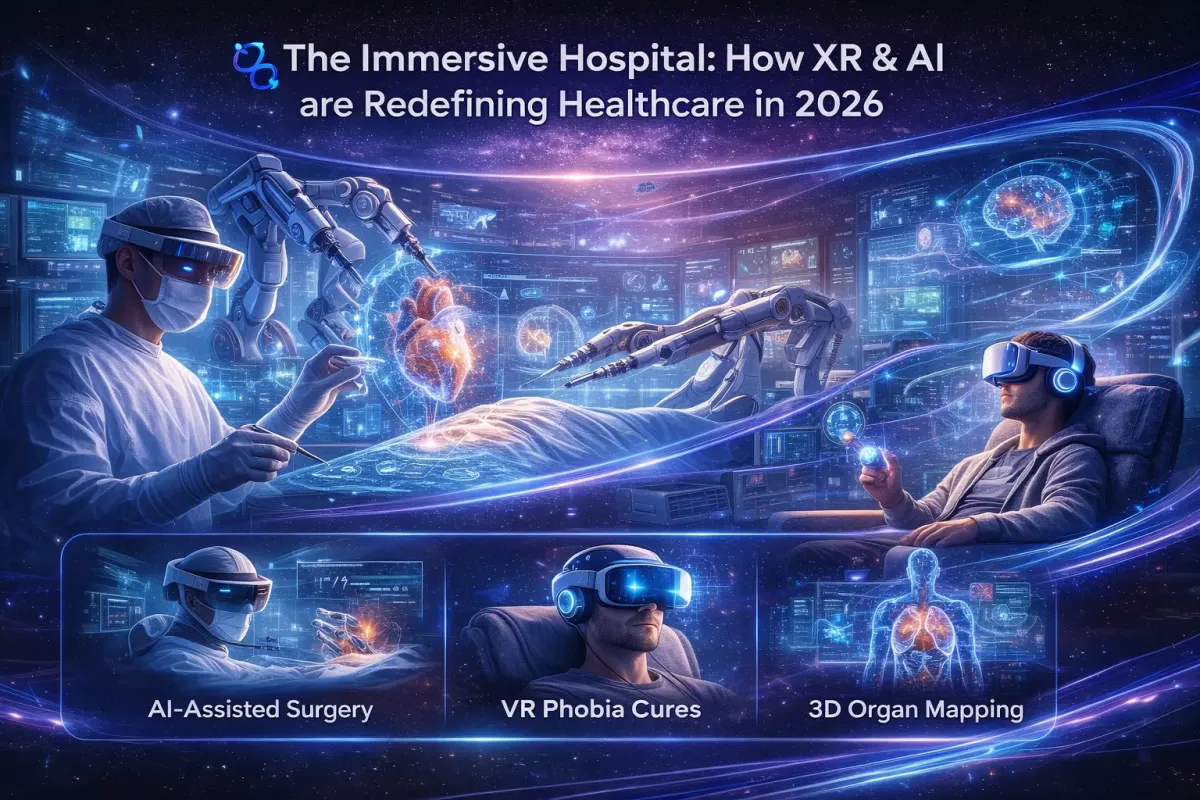
1. Introduction: The Prescription for a Virtual World
For decades, the medical field was limited by the physical: doctors could only practice on cadavers, and therapy was confined to a four-walled office. But as we reach 2026, the boundaries of biology have been extended by silicon.
Virtual Reality (VR), Augmented Reality (AR), and Mixed Reality (MR) collectively known as XR have moved from "tech experiments" to essential clinical tools. In 2026, your surgeon likely practiced your specific operation 50 times in a digital twin of your body before ever picking up a scalpel. This article explores the three pillars of XR Healthcare: Precision Surgery, Advanced Neuro-rehabilitation, and AI-Powered Patient Education
2. Surgical Precision: The Rise of "X-Ray Vision"
In 2026, the operating room (OR) looks more like a sci-fi set. Surgeons no longer look away from the patient to check a monitor, the data is right where they need it.
A. Holographic Navigation and Intraoperative AR
Using headsets like the Microsoft HoloLens 3 or Magic Leap 3, surgeons can overlay a 3D holographic map of the patient's internal anatomy directly onto their body.
- The "X-Ray Vision" Effect: By integrating real-time MRI and CT scans, the AR system highlights tumors, blood vessels, and nerves in glowing colors. This allows for "sub-millimeter" precision, reducing the risk of accidental damage to healthy tissue.
- AI-Guided Checklists: AI agents within the headset monitor the surgery in real-time, providing voice-activated checklists and alerting the surgeon if they deviate from the pre-planned path.
B. Remote Robotic Surgery with VR
2026 has seen the first successful transcontinental surgeries where the specialist is in London and the patient is in Hanoi. The surgeon uses a high-fidelity VR headset and haptic gloves to control a surgical robot with near-zero latency, thanks to 5G-Advanced and 6G experimental networks.
3. Mental Health: The Virtual Pharmacy for the Mind
Mental health treatment has seen its biggest leap in a century. VR is now a primary treatment for PTSD, Anxiety, and Chronic Pain.
- Exposure Therapy 3.0: In 2026, AI-driven VR environments allow patients to face their phobias (heights, crowds, spiders) in a 100% controlled setting. The AI monitors the patient’s heart rate and pupil dilation, adjusting the intensity of the simulation to ensure it remains therapeutic and not re-traumatizing.
- Pain Management without Opioids: "Virtual Painkillers" are now a standard prescription. By immersing chronic pain patients in highly engaging, beautiful VR worlds, the brain’s "Pain Gates" are effectively closed. Studies in late 2025 showed that 20 minutes of VR therapy can reduce pain perception by up to 35%, outperforming many traditional medications.
👉 Fill Up Serena With Your Cum
4. Technical Breakdown: The Architecture of Medical XR (2026 Standard)
To be used in a medical setting, XR hardware in 2026 must meet rigorous "Grade-A" standards that far exceed consumer gaming headsets.
Visual Fidelity and Latency
The medical standard for 2026 is 16K combined resolution with a refresh rate of 144Hz. This is critical because any "flicker" or lag during a surgery can lead to catastrophic errors. The Snapdragon XR2 Gen 3 chip features a dedicated "Medical Core" that prioritizes sensory data, ensuring the "motion-to-photon" latency is kept under 7ms.
Biometric Integration
2026 headsets are equipped with Medical-Grade Biosensors. These aren't just for tracking eyes, they monitor EEG (brainwaves), ECG (heart rhythm), and Galvanic Skin Response (stress levels). This data is fed into a "Local Medical AI" that protects patient privacy by encrypting all data before it ever hits a server.
Sterilization and Ergonomics
The hardware has evolved. 2026 surgical headsets are made from Anti-microbial Polymers and are designed to be fully sterilized with UV-C light without damaging the sensitive lenses or cameras.
5. Medical Education: The End of "See One, Do One, Teach One"
The old medical training adage is dead. In 2026, it's "Simulate One, Master One, Perform One."
- Digital Twin Organs: Medical students no longer rely solely on generic textbooks. They can pull up a Digital Twin of a rare heart condition and "walk through" the valve, seeing the blood flow in real-time.
- Soft-Tissue Haptics: The latest haptic gloves allow students to feel the "squishiness" of a liver or the "hardness" of a tumor. This tactile feedback is essential for building the muscle memory required for real-world procedures.
👉 Luna Legend Will Make You Cum
6. Physical Rehabilitation: Gaming Your Way to Health
Stroke survivors and patients with spinal injuries are finding new hope in Gamified Rehabilitation.
- The "Avatar" Motivation: In 2026, patients perform their repetitive physical therapy exercises inside a VR game. As they move their arms, their virtual avatar might be flying a plane or fighting dragons.
- Neuroplasticity Tracking: The AI tracks the patient's progress at a granular level, measuring the exact degree of joint movement and speed, providing doctors with a "Recovery Curve" that was previously impossible to calculate.
7. Ethical and Security Challenges: Protecting the Human Body
With great power comes great risk. 2026 healthcare faces three major challenges:
- Cybersecurity of Surgical Robots: What happens if a surgical headset is hacked mid-operation? The 2026 "Med-Secure" protocol mandates that all surgical XR devices have a physical "Kill Switch" and an offline backup mode.
- Biometric Sovereignty: Patients are now the owners of their "Digital Biological Data." Laws in 2026 prevent insurance companies from using VR-gathered health data (like eye-tracking signals for early Parkinson's) to raise premiums.
8. Conclusion: A New Era of Healing
The year 2026 marks the moment we stopped fighting disease with only chemicals and steel, and started using light and data. XR is no longer a luxury, it is a human right to have access to the most precise, empathetic, and effective care that technology can provide.
The hospital of 2026 is no longer just a building, it is a Spatial Health Network that extends from the operating room to the patient's living room, powered by the invisible magic of XR and AI.