
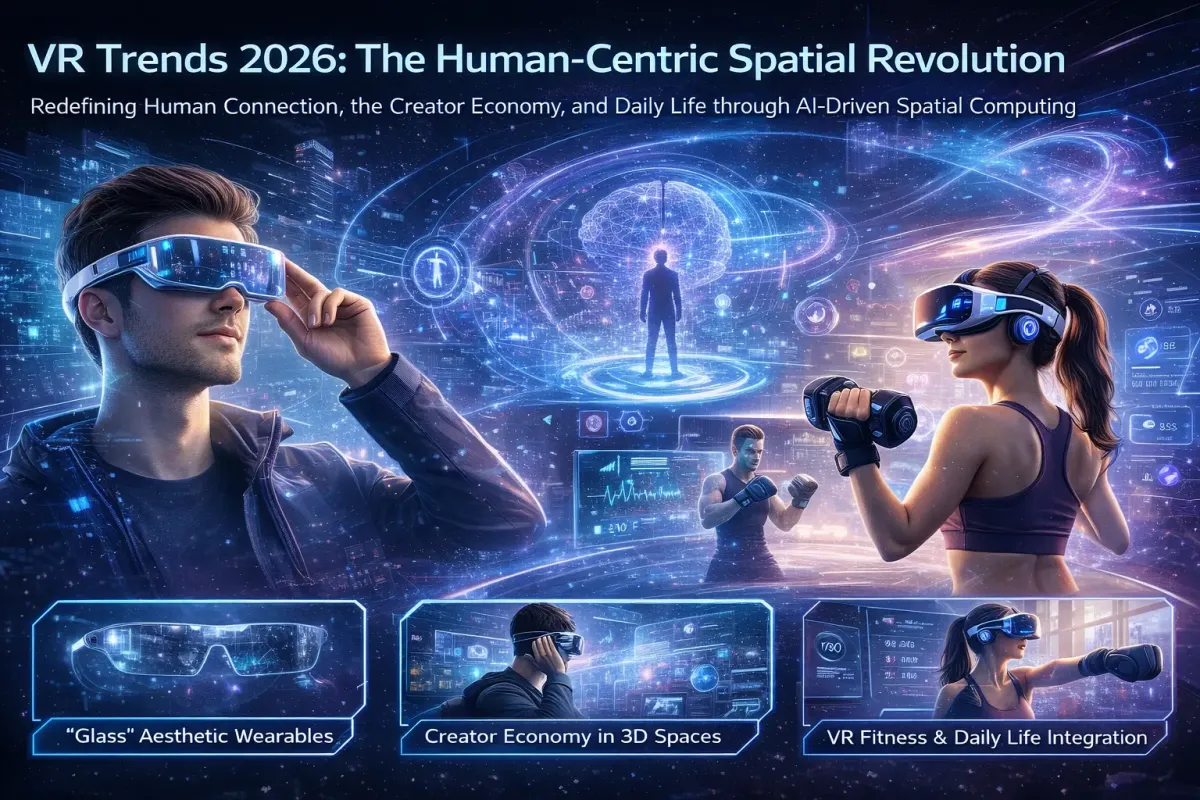
By January 2026, the conversation around Virtual Reality (VR) has shifted. We are no longer asking if the technology works or when it will go mainstream. Instead, we are navigating a world where Spatial Computing has woven itself into the fabric of our daily lives.
In 2026, VR isn't just about "escaping" reality, it’s about expanding it. It is the year where digital presence feels as heavy as physical presence, and where the "Creator Economy" has moved from 2D screens into 3D inhabited spaces.
1. The Aesthetic Shift: VR as a Fashion Statement
In 2026, the "form factor" hurdle has been cleared. The headsets of 2023 heavy, plastic, and isolating have been replaced by Lifestyle Wearables.
1.1. The Rise of "Glass" Aesthetics
Collaborations between tech giants (Apple, Meta, Samsung) and fashion houses (Luxottica, LVMH) have produced devices that look like high-end eyewear. These devices utilize Light Field displays, allowing the lenses to remain transparent when not in use, solving the social awkwardness of "wearing a computer on your face."
1.2. All-Day Wearability
Thanks to the decoupling of processing units (now stored in a puck in your pocket or processed via the cloud), the weight on the bridge of the nose has dropped below 100 grams. In 2026, people wear their "spatial glasses" as naturally as they wear a smartwatch.
2. Social Architecture: The Death of Distance
The most profound impact of VR in 2026 is on Human Connection. We have moved past the "uncanny valley" of avatars.
2.1. Photorealistic Presence (Codec Avatars)
Social platforms now utilize AI-driven photorealistic avatars. When you call a family member across the world, they don't appear as a cartoon, they appear as a volumetric, high-fidelity version of themselves. They can sit on your actual sofa, and through eye-tracking and facial-muscle sensors, every micro-expression is conveyed.
2.2. The "Third Space"
In 2026, we are seeing the rise of Virtual Neighborhoods. These aren't just games, they are persistent digital towns where people "hang out" before or after work. Architects are now being hired to design "impossible" social spaces buildings that defy gravity or change their interior design based on the mood of the inhabitants.
3. The Spatial Creator Economy 2.0
The move to 3D has birthed a new class of millionaires: the Spatial Creators.
3.1. From Video to Experience
In 2024, creators made videos. In 2026, they make Experiences. A travel influencer doesn't just show you a video of the Amalfi Coast, they sell a "Spatial Snapshot" that allows you to walk through that specific moment, feel the ambient temperature (via haptic suits), and hear the localized soundscape.
3.2. Generative World-Building as a Service
With AI tools like Text-to-Space, a new profession has emerged: the Prompt Architect. These individuals specialize in using AI to generate complex, high-performance virtual environments for brands, concerts, and private events, making the "Metaverse" infinitely expandable and personalized.
4. Neuro-Immersive Gaming & Entertainment
Gaming remains the "bleeding edge" of VR, but in 2026, it has become Neuro-Immersive.
4.1. BCI-Lite (Brain-Computer Interface)
While full Neuralink-style implants remain niche, "BCI-Lite" sensors in the headset's headband are common. These sensors detect your emotional state (frustration, excitement, boredom) and adjust the game’s difficulty or narrative arc in real-time to keep you in a state of "flow."
4.2. Galvanic Vestibular Stimulation (GVS)
The "nausea" problem has been solved for 99% of the population. High-end headsets now use GVS technology, which sends tiny electrical signals to the inner ear to trick the sense of balance. If you fly in VR, your inner ear feels the tilt, eliminating the sensory mismatch that caused motion sickness in the past.
5. Sustainability: The Green Side of Virtual Reality
An unexpected trend in 2026 is VR’s role in Climate Action.
- Virtual Tourism: To protect fragile ecosystems, governments are offering "High-Def VR Passes" to locations like the Galapagos or Antarctica. This allows millions to experience the wonder without the carbon footprint of a flight or the physical impact on the land.
- Zero-Waste Prototyping: The fashion and automotive industries have reduced physical prototyping by 80%. Every stitch and bolt is tested in a "Physics-Perfect" VR simulation before a single physical resource is used.
6. The "Digital Sovereignty" Crisis
With these advancements come the darker trends of 2026.
6.1. Biometric Identity Theft
Because headsets track your iris, your gait, and your heart rate, Biometric Privacy is the biggest legal battleground of the year. Hackers don't want your password anymore, they want your "Spatial DNA."
6.2. The Reality Disconnect
Psychologists are seeing an increase in "Post-VR Depressive Syndrome" a feeling of letdown when returning to the "grayer, slower" physical world after spending hours in a vibrant, AI-optimized virtual paradise. This is leading to a movement for "Digital Minimalism" and mandatory "Reality Breaks."
7. Conclusion: The Invisible Technology
As we look at the trajectory of 2026, the ultimate goal of VR is becoming clear: to become invisible. The most successful VR experiences this year are the ones where you forget you are using technology at all. Whether it’s a doctor feeling the resistance of a virtual heart during surgery, or a grandmother "holding" the hand of her grandson 5,000 miles away, VR has finally moved from being a screen we look at to being a world we live in.
The "Virtual" has finally become "Reality."