
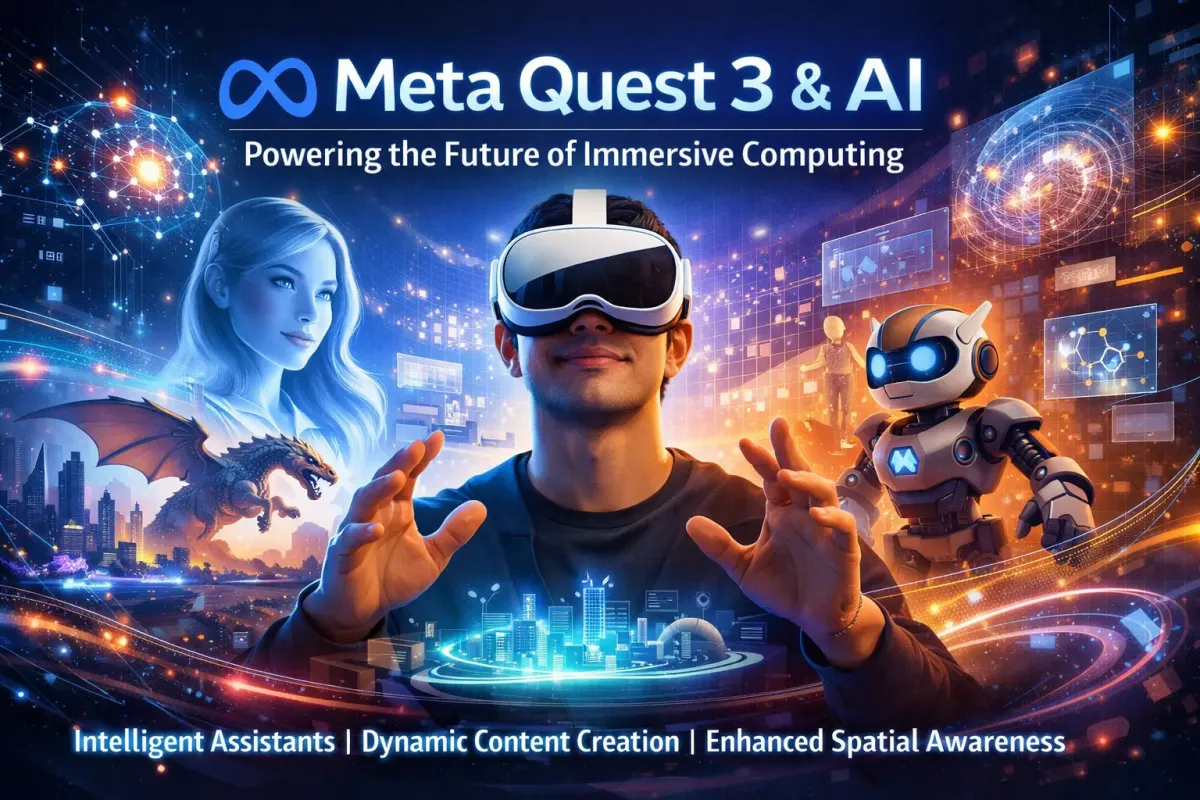
When the Meta Quest 3 launched, it wasn't just another incremental upgrade, it was a foundational brick in the rapidly expanding edifice of immersive computing. Its thinner profile, sharper passthrough, and enhanced processing power hinted at a future far beyond simple gaming. However, the true unlock for the Quest 3’s long term impact isn’t merely in its silicon and lenses, but in its symbiotic relationship with Artificial Intelligence. In 2026, the Quest 3, or its iterative successors building on its core architecture, is no longer just a VR headset, it's a window into an AI powered spatial intelligence that redefines how we interact with digital worlds and the physical world simultaneously.
This deep dive will explore how AI amplifies the Quest 3's capabilities across various domains, from enhancing user experience and content creation to facilitating novel forms of interaction and accessibility, laying the groundwork for the true Metaverse.
Chapter 1: The Quest 3's Hardware as an AI Enabler
The Meta Quest 3's technical specifications are crucial to understanding its role as an AI platform. Unlike previous standalone headsets, its upgraded hardware isn't just about pushing more pixels, it's about providing the robust foundation necessary for sophisticated on device AI operations.
1.1. Enhanced Processing Power & Neural Engine Integration
The Quest 3 features Qualcomm's Snapdragon XR2 Gen 2 platform, a significant leap from its predecessor. This chip boasts a dedicated Neural Processing Unit (NPU) which is vital for AI workloads.
- On-Device Inference: This NPU allows many AI algorithms to run directly on the headset, reducing latency and reliance on cloud processing. For example, real-time hand tracking, object recognition in passthrough, and intelligent upscaling of graphics can happen instantly, leading to a much smoother and more responsive experience.
- Power Efficiency: Running AI tasks on the NPU is significantly more power-efficient than relying solely on the CPU or GPU, extending battery life a critical factor for prolonged immersive sessions.
1.2. High-Fidelity Passthrough and Environmental Understanding
The Quest 3's full-color, high resolution passthrough is a game changer for Mixed Reality (MR). This isn't just about seeing the real world, it's about the headset understanding it.
- Spatial Mapping: AI algorithms work in conjunction with the depth sensors and cameras to build a highly accurate 3D mesh of your physical environment. This room scale mapping is persistent, meaning the headset remembers your space, allowing virtual objects to interact convincingly with real world surfaces.
- Object Recognition: Beyond mapping, AI identifies specific objects like furniture, walls, and even people. This contextual awareness enables virtual content to react intelligently a virtual ball bouncing off a real table, or a digital character navigating around your actual sofa. This is fundamental for realistic mixed reality interactions.
1.3. Advanced Tracking Systems
From inside-out tracking to improved hand tracking, AI optimizes every aspect of user input.
- Predictive Tracking: AI models analyze your head and hand movements, predicting your next motion to smooth out tracking errors and reduce perceived latency, crucial for combating motion sickness and improving immersion.
- Gesture Recognition: Beyond basic hand tracking, AI interprets complex gestures, allowing for more intuitive and natural interactions without the need for physical controllers in many applications. This is key for intuitive VR/AR interfaces.
Chapter 2: AI-Powered User Experience Enhancements
AI within the Quest 3 transforms the user journey from a clunky interaction to a seamless, personalized, and intuitive experience.
2.1. Intelligent Virtual Assistants
Imagine a truly smart assistant embedded directly into your spatial computing environment.
- Context-Aware Help: Instead of generic responses, an AI assistant on the Quest 3 understands your current context, whether you're in a game, a productivity app, or just browsing. If you're struggling with a puzzle in a VR game, the assistant can offer subtle, context specific hints without breaking immersion.
- Personalized Recommendations: Based on your interactions, play style, and even biometric data (if enabled, measuring engagement or frustration), the AI can recommend games, apps, or even social spaces tailored to your preferences, fostering personalized immersive experiences.
2.2. Dynamic Content Generation & Adaptation
The static nature of traditional content is giving way to dynamic, AI generated experiences.
- Adaptive Difficulty: In gaming, AI can dynamically adjust enemy AI, level layouts, or puzzle complexity based on your skill level and real-time performance, ensuring optimal engagement and challenge. This is crucial for VR gaming longevity.
- Procedural World Building: AI can generate vast, unique virtual environments on the fly. This means endless exploration in adventure games, or new social spaces that are constantly evolving, overcoming the limitations of pre rendered content for scalable virtual worlds.
- Narrative Branching: For story driven experiences, AI can create branching narratives based on user choices or even subtle emotional cues, leading to highly personalized and replayable stories, a hallmark of next-gen interactive storytelling.
2.3. Enhanced Accessibility and Inclusivity
AI is making immersive experiences more accessible to a broader audience.
- Real-time Translation & Captioning: For international collaboration or social VR, AI can provide real-time audio translation and generate captions for spoken words, breaking down language barriers in global virtual communities.
- Adaptive Interfaces: AI can detect user capabilities (e.g., limited hand dexterity) and dynamically adjust interface elements, button sizes, or control schemes to optimize usability, making VR more inclusive.
- Sensory Augmentation: For users with sensory impairments, AI can convert audio cues into visual alerts or vice-versa, enriching the experience and providing vital information in accessible immersive environments.
Chapter 3: AI for Advanced Spatial Computing & Mixed Reality
The Quest 3's passthrough capabilities, combined with AI, are blurring the lines between the digital and physical, ushering in the era of true mixed reality.
3.1. Realistic Virtual Object Integration
AI ensures that virtual objects don't just "float" in your room but convincingly interact with it.
- Shadow Casting & Occlusion: AI intelligently calculates and renders realistic shadows cast by virtual objects onto real surfaces. Crucially, it also handles real world occlusion, meaning if a real person walks in front of a virtual character, the character is correctly blocked from view, massively boosting mixed reality realism.
- Lighting Estimation: AI analyzes the real world lighting conditions (color temperature, intensity, direction) and adjusts the rendering of virtual objects to match, making them appear physically present and consistent with your environment.
3.2. Intelligent Digital Twins & Contextual Augmentation
The concept of a "digital twin" extends beyond industrial applications to everyday life.
- Smart Home Interaction: Your Quest 3 can become a central hub for your smart home. AI recognizes your devices and allows you to interact with them spatially, adjusting thermostat settings by "touching" a virtual dial on your wall, or turning off lights with a glance and a gesture. This facilitates intuitive smart home control.
- Augmented Instructions & Guides: For tasks like DIY repairs or assembling furniture, AI can project holographic instructions directly onto the object you're working on, highlighting parts, showing assembly steps, and even identifying tools. This provides contextual instructional overlays.
3.3. Enhanced Social Presence in Virtual Worlds
AI makes virtual interactions feel more natural and human.
- Photorealistic Avatars (Codecs Avatars): Meta's research into Codecs Avatars uses AI to generate highly realistic, dynamically animated avatars from minimal input, capturing subtle facial expressions and body language, leading to hyper realistic social VR.
- Emotional AI: By analyzing voice tone, facial expressions (from headset cameras), and movement patterns, AI can interpret a user's emotional state and allow their avatar to reflect it, or even suggest content that aligns with their mood, enriching emotional depth in virtual interactions.
Chapter 4: The Developer's AI Toolkit on Quest 3
Meta provides developers with robust AI tools and APIs, making it easier to integrate these advanced capabilities into their applications.
4.1. Passthrough API & Scene Understanding SDK
These SDKs give developers access to the Quest 3's environmental data and AI-processed understanding of the world.
- Custom MR Experiences: Developers can build unique mixed reality apps that leverage the headset's spatial mapping and object recognition to create games where virtual elements hide behind real world furniture, or productivity tools that anchor information to specific physical locations. This empowers innovative mixed reality development.
4.2. Voice SDK & Natural Language Processing (NLP)
Integrating advanced NLP allows for more natural voice commands and interactions within apps.
- Hands-Free Interaction: Users can navigate menus, control game elements, or query information purely through natural speech, reducing the need for controllers and creating a more seamless experience. This is crucial for hands free VR/AR interaction.
4.3. Machine Learning (ML) Models for Developers
Meta offers pre-trained ML models that developers can integrate for common AI tasks, lowering the barrier to entry for AI-powered features.
- Gesture Libraries: Developers can access ML models for recognizing a wide range of hand gestures, allowing them to implement intuitive, controller-free input methods into their applications. This promotes gesture-based interaction design.
Chapter 5: Long Term Implications and the Future of AI on Quest like Devices
The foundational work being done with the Quest 3 and AI points towards a much larger future for immersive computing.
5.1. The Personalized Metaverse
AI will be the architect of a truly personalized metaverse. Every individual's experience will be uniquely tailored, from the content they see to the virtual spaces they inhabit and the social interactions they have. This is the vision of a truly personalized digital identity.
5.2. Proactive AI Companions
Future iterations will likely feature more proactive AI companions that learn your routines, anticipate your needs, and offer relevant spatial information without explicit prompts. Think of an AI that notices you're looking at a specific appliance and projects its manual, or gently reminds you of an upcoming appointment with a visual cue in your periphery. This is the evolution towards proactive spatial computing.
5.3. Bridging Physical and Digital Workflows
AI will increasingly streamline workflows by seamlessly integrating digital tools into physical environments. For architects, walking through a building site with AR glasses could mean seeing a holographic overlay of the proposed design, with AI highlighting structural discrepancies in real-time. For educators, a teacher could see dynamic, AI generated information about each student's learning progress anchored to their physical presence in the classroom. This facilitates seamless digital-physical workflows.
5.4. Ethical Considerations and Data Privacy
The deep integration of AI, especially with biometric and environmental data, raises significant ethical questions.
- Data Sovereignty: Who owns the spatial map of your home? How is your emotional data protected? These questions of VR data privacy and AI ethics in XR will be paramount in the coming years.
- Algorithmic Bias: Ensuring AI models are fair and unbiased in content generation, recommendations, and avatar creation will be critical for an equitable metaverse. This addresses algorithmic fairness in immersive tech.
Conclusion: The Quest for Intelligent Immersion
The Meta Quest 3 is more than just a VR headset, it's a testament to the power of integrating robust hardware with advanced Artificial Intelligence. From making everyday tasks frictionless with augmented reality to creating infinitely engaging and personalized virtual worlds, AI is the engine driving the Quest 3's transformative potential. As both the hardware and AI models continue to evolve, the distinction between our physical and digital lives will become increasingly blurred, not in a way that subtracts from reality, but one that richly augments and intelligently enhances it. The journey towards truly intelligent immersive computing is well underway, and the Quest 3 stands as a pivotal milestone in this exciting future.