
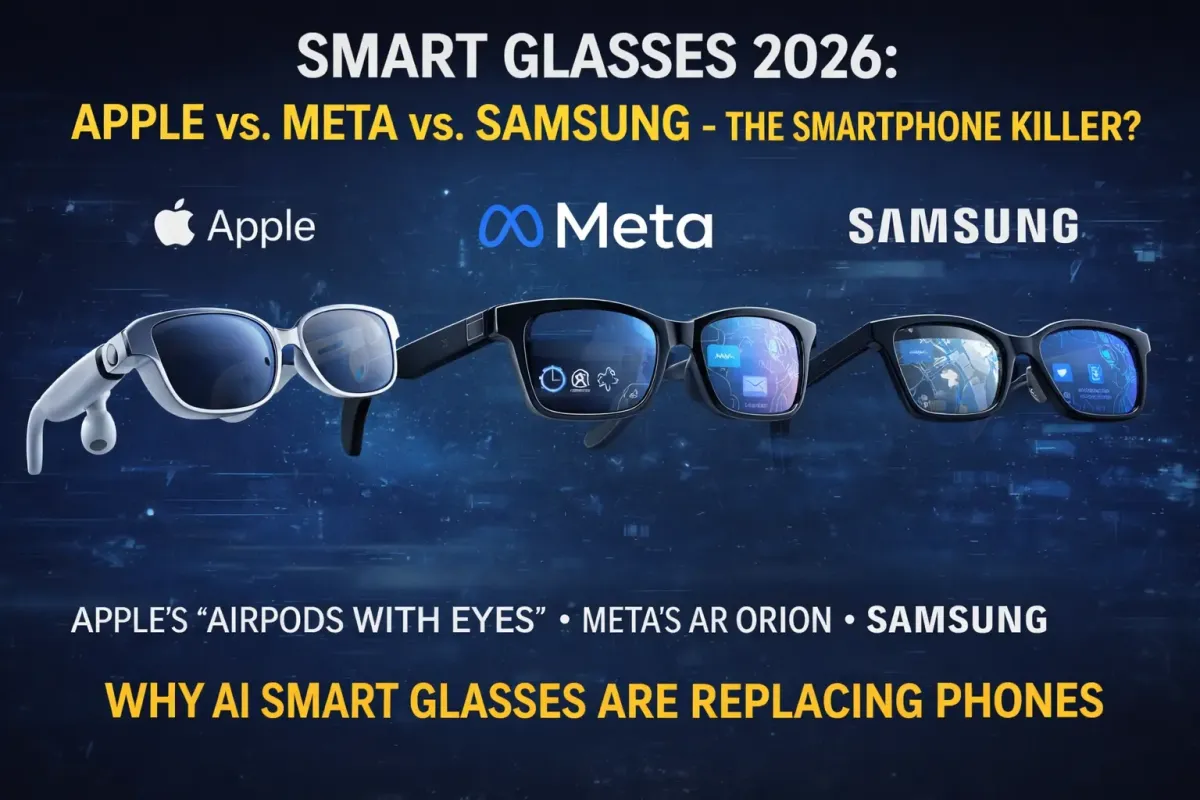
1. Introduction: The Post-Smartphone Era Begins
In 2026, the question is no longer "Will you buy a VR headset?" but "When will you replace your phone with a pair of glasses?" We are entering the Ambient Computing era.
While headsets like the Vision Pro were "computers for your face," the devices of 2026 are "AI companions for your life." With Meta, Apple, and the Samsung-Google alliance all slated to release lightweight, AI-driven glasses, the race is on to see who can make technology truly invisible.
2. Apple’s "Project Atlas": AirPods with Eyes
Apple’s strategy for 2026 has pivoted. Instead of a lightweight Vision Pro, rumors point to a product codenamed "Project Atlas" a pair of smart glasses focused on Visual Intelligence.
- The Vision: Apple isn't aiming for full AR overlays yet. Instead, imagine "AirPods with eyes." These glasses will feature cameras, microphones, and speakers integrated with Apple Intelligence.
- Key Features: Real-time object recognition, instant translation through Siri, and "Visual Search" that tells you the price of a jacket or the history of a landmark just by looking at it.
- The Tether: To keep them lightweight (<75g), the glasses will likely offload heavy processing to your iPhone, acting as a seamless secondary display for your life.
3. Meta’s Orion & The Ray-Ban Evolution
Meta is currently the leader in this space with the Ray-Ban Meta glasses. In 2026, they are expected to take two massive leaps:
A. Ray-Ban Meta Gen 3 (Mass Market)
The next generation will likely include a HUD (Heads-Up Display) in one lens, allowing for text notifications and simple navigation without the bulk of full AR.
B. Project Orion (The Developer Grail)
Meta's true AR glasses, Orion, are expected to reach a wider developer group in 2026. With a 70-degree field of view and magnesium frames, Orion allows for full holograms to be projected into the real world, controlled by a neural wristband that reads your intent.
4. The Samsung-Google Alliance: Android XR Glasses
After years of silence, the "Google-Samsung-Qualcomm" trifecta is officially launching its Android XR Glasses in 2026.
- Project Aura: This is Google's push to bring Gemini AI into a pair of glasses.
- Seamless Ecosystem: Unlike Apple's closed garden, Samsung’s glasses are designed to work across all Android devices. A major selling point is "Circle to Search" in real life look at something, gesture with your finger, and Google tells you everything about it.
5. Technical Breakdown: The Architecture of 2026 Glasses
The move toward lightweight glasses requires a fundamental change in hardware compared to the VR headsets of 2025.
Optical Standards
The industry has standardized on Micro-LED and Waveguide technology. Unlike the bulky lenses in a Quest 3, waveguides are thin layers of glass that "steer" light from a tiny projector in the frame directly into your eye. This allows the glasses to look almost identical to regular Wayfarers or Aviators.
Processing & AI
The processing has moved to a Distributed Model. The glasses handle "low-latency" tasks like camera input and audio, while the "heavy lifting" (AI reasoning, 3D rendering) is handled by your smartphone via Wi-Fi 7. This is the only way to achieve 12-hour battery life in a frame that weighs less than 100 grams.
Input: The Death of the Controller
2026 is the year we stop carrying controllers. Input is now a "tri-modal" experience:
- Voice: Conversational AI (Siri, Gemini, Llama 3).
- Gaze: Looking at what you want to select.
- Neural: Wristbands that detect micro-gestures of your fingers via EMG (Electromyography).
6. Health & Ergonomics: The All-Day Wear Challenge
For smart glasses to succeed in 2026, they must solve the "Wearing Fatigue" issue.
- Thermal Management: Using 3nm chips, companies have reduced heat output, ensuring the temples of the glasses don't burn the user's skin after an hour of AI use.
- Prescription Integration: Both Apple and Meta have simplified the "Prescription Lens" process, allowing users to snap in magnetic lenses in seconds.
7. Security: The "Always-On" Privacy Debate
The biggest hurdle for 2026 isn't the battery, it's Social Acceptance.
- The Recording Light: 2026 models feature highly visible LED rings to signal when cameras are active, but concerns about "passive spying" remain.
- Data Sovereignty: With glasses seeing everything you see, "Spatial Privacy" laws are being enacted. Users in 2026 are demanding "Zero-Knowledge AI", where the glasses process your visual data but never store your face or home layout on a corporate server.
8. Technical Breakdown: The Architecture of 2026 Glasses
The transition to 2026 smart glasses is built on a radical departure from the architecture of previous years.
Firstly, we have seen a shift in Optical Standards toward Micro-LED and Waveguide technology. In 2024, AR glasses often looked bulky because they used traditional prism optics. By 2026, waveguides microscopic gratings etched into thin glass allow light to be "guided" from a tiny projector into the wearer's eye, enabling a form factor that is indistinguishable from standard fashion eyewear.
Secondly, the processing model has evolved into a Distributed Architecture. Instead of trying to fit a computer inside the frame, 2026 glasses use the Snapdragon XR2 Gen 3 primarily for sensor fusion and low-latency audio. The "heavy" generative AI tasks are offloaded to a smartphone or a pocket-sized compute puck via Wi-Fi 7. This ensures the glasses stay cool and maintain an all-day battery life.
Finally, the Input Systems have been revolutionized. 2026 marks the decline of the physical controller in favor of a Tri-modal Interface. This combines Natural Language AI for complex commands, High-precision Gaze Tracking for selection, and Neural Wristbands (EMG) that allow users to click or scroll by simply twitching their fingers, even if their hands are in their pockets.
9. Conclusion: The Final Screen
The year 2026 is the beginning of the end for the "Black Slate" in our pockets. As AI becomes our primary interface, the screen is moving from our hands to our eyes. Whether you choose Apple's elegant ecosystem, Meta’s social-first holograms, or Samsung's open Android XR world, one thing is certain: The future is transparent.