
1. Introduction: The New Frontier of Trust
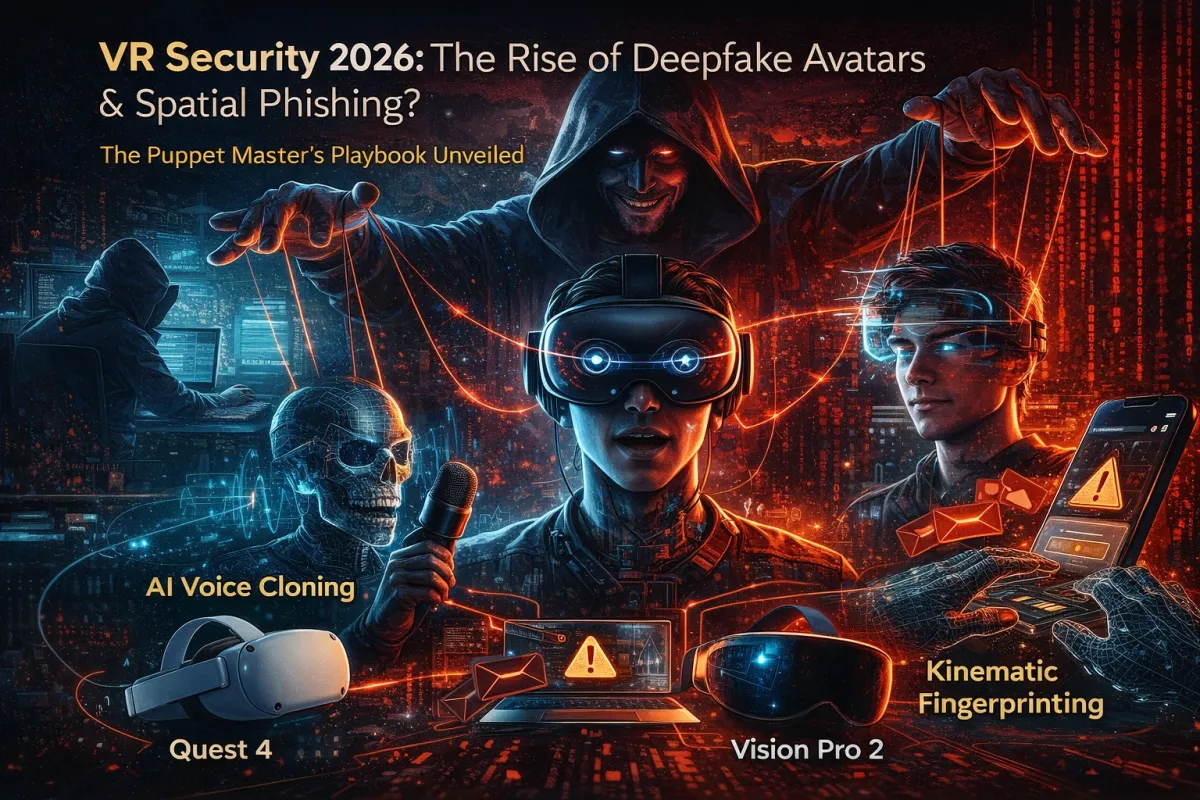
In the 2020s, phishing meant a fake email. In 2026, phishing is a human-to-human interaction. Imagine standing in a virtual boardroom, talking to an avatar that looks, moves, and sounds exactly like your CEO. You share sensitive company data, only to realize later that the "CEO" was a high-fidelity AI Deepfake.
As the boundaries between physical and digital realities vanish, the concept of "identity" has become fluid and extremely vulnerable.
2. Spatial Phishing: The "Inside-Out" Attack
The most dangerous attack of 2026 is Spatial Phishing. Unlike traditional scams, this happens inside your trusted XR environment.
- Malicious Overlays: Hackers can inject a "transparent layer" over your OS. When you go to pay for a game, the credit card field you see is actually a fake overlay designed to harvest your 20-digit spatial payment code.
- Environmental Mimicry: A hacker can "clone" your friend’s virtual home. They invite you over, and while you’re distracted by the 8K decor, they use "Ghost Applications" to scan your headset’s local cache for sensitive work documents.
3. Kinematic Fingerprinting: You Cannot Hide Your Moves
In 2026, even if you wear a generic avatar and use a voice changer, you can still be identified. This is called Kinematic Fingerprinting.
- The Science: Research from 2025 has confirmed that every human has a unique "skeletal signature" the way your shoulders shrug, how your head tilts when you laugh, and the micro-jitters in your hand movements.
- The Exploit: Aggressive advertising networks and hackers are "scraping" this movement data. Once they have your kinematic signature, they can track you across different platforms and anonymous accounts, effectively ending online anonymity in the Metaverse.
4. Avatar Hijacking & Deepfake Presence
With the release of the Apple Vision Pro 2 and its "Persona" technology, digital avatars have become photorealistic. This has led to the rise of Presence Theft.
A. AI Voice & Motion Cloning
Using just 30 seconds of recorded audio and 5 minutes of motion data (easily gathered in public social VR spaces like VRChat), an attacker can create a Neural Avatar.
- The Scam: This AI-driven clone can attend meetings, authorize transactions, or manipulate your social circle. In 2026, "I saw them in VR" is no longer proof that a person was actually there.
B. The "Man-in-the-Room" Attack
Hackers exploit the spatial mapping data of your room. By gaining access to your headset's LiDAR or depth sensors, they can "see" your physical home. They know where your safe is, what kind of security system you have, and even your daily routine based on when you use the headset.
5. Technical Protection: The Zero-Trust XR Architecture (Text Analysis)
The transition from 2024 to 2026 represents a fundamental shift in how immersive devices protect user data. While the Quest 3 laid the groundwork, the next generation of headsets like the Meta Quest 4 and Apple Vision Pro 2 introduces a multi-layered security model that assumes every connection is potentially compromised.
Continuous Authentication vs. Static Passcodes
In 2024, security was "static," relying on a one-time Passcode or Pattern. If a user was tricked into handing over their headset while logged in, the attacker had full access. By 2026, we have moved to Continuous Authentication. Technologies like Optic ID and Iris ID (on the Vision Pro 2) or Eye-Unlock (on the Quest 4) constantly verify the user's identity in the background. If the headset detects an "impossible" movement pattern or an unrecognized iris, it locks the session instantly, even mid-use.
Hardware-Isolated Secure Enclaves
While 2024 headsets used standard encrypted enclaves, the 2026 standard is a Hardware-Isolated Secure Enclave. This is a "black box" within the processor (like the Snapdragon XR2 Gen 3 or Apple M5) that is physically partitioned from the main Operating System. Sensitive biometric data, such as your Iris Map or Kinematic Signature, never leaves this isolated environment. Not even the OS or a compromised app can "read" the raw data, they only receive a "Yes/No" confirmation of identity.
Network Security with Wi-Fi 7 and MLO
Network security has evolved from WPA3 on Wi-Fi 6 to Wi-Fi 7 with Multi-Link Operation (MLO) Encryption. In 2024, hackers could attempt "Man-in-the-Middle" attacks on a single frequency. In 2026, MLO allows the headset to transmit data fragments across 2.4GHz, 5GHz, and 6GHz simultaneously. Because the data is fragmented and encrypted across multiple bands, it is virtually impossible for an interceptor to reconstruct the original stream.
Edge Processing vs. Cloud Sync
The data policy has shifted from "Cloud-Sync Opt-out" to Mandatory On-Device Edge Processing. In 2024, many biometric features required cloud processing to be effective. In 2026, the raw power of dedicated NPUs (Neural Processing Units) allows all spatial mapping and eye-tracking analysis to happen locally. Your room’s layout and your gaze history never touch a server, eliminating the risk of a massive "Metaverse data breach."
6. Summary: 5 Rules for Digital Survival in 2026
To stay safe in this new reality, users must adopt a Security-First Mindset:
- Treat Avatars with Skepticism: If a friend asks for money or secrets in VR, use a secondary "Out-of-Band" verification (like a physical phone call).
- Audit Your Spatial Maps: Regularly delete the 3D scans of your room in your headset settings.
- Use Privacy "Zones": Only use sensitive apps in a "Digital Safe Zone" a virtual room where all external sensors and social features are disabled.
- Hardware Mutes: Use the physical mute button for your microphone when not speaking to prevent "Voice-Scraping" by background apps.
- Multi-Biometric MFA: Ensure your XR accounts require both Iris ID and a physical security key (like a YubiKey).
7. Conclusion: The Reality of Trust
The year 2026 has taught us that in the Metaverse, seeing is no longer believing. Our biometric data is our most valuable asset, yet it is also our greatest vulnerability.
The future of XR security isn't just about better firewalls, it’s about "Human-Centric Resilience." As we blend our lives with the digital world, we must ensure that we remain the sole owners of our digital twins and the spaces they inhabit.