
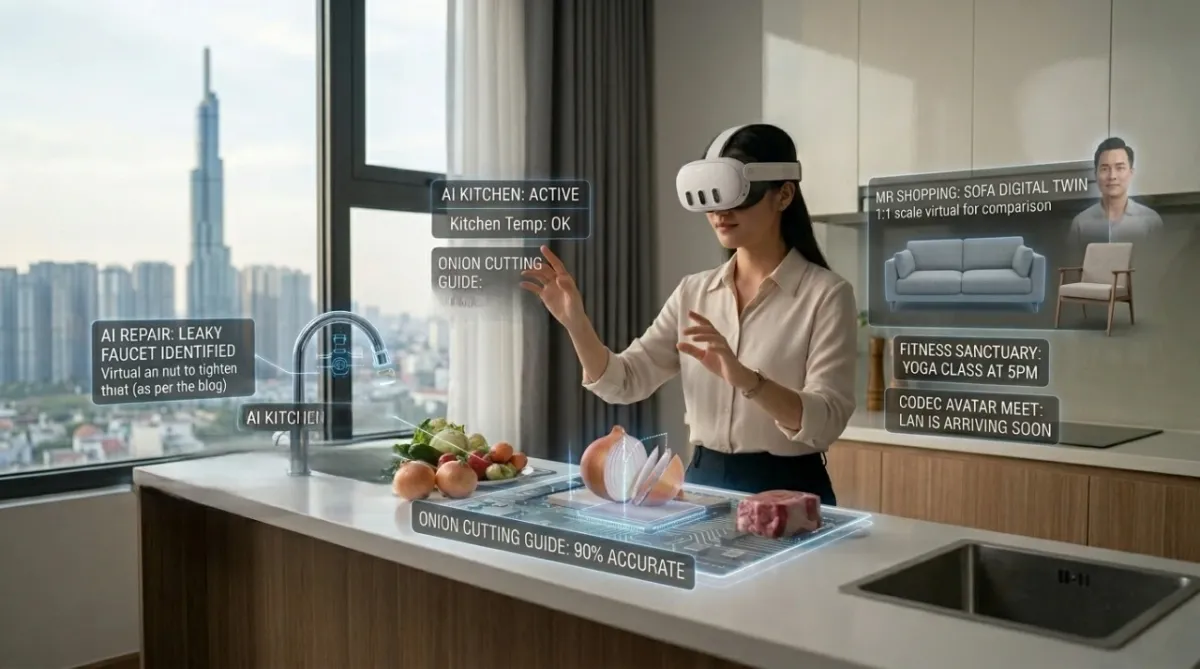
By the middle of 2026 the way we inhabit our homes has undergone a quiet but profound transformation. In years past virtual reality was something we went into to escape the world. But today with the Meta Quest 3 and the more affordable Quest 3s the technology is something we use to enhance the world we already live in. This is the era of the Spatial Home where the physical walls of your house are no longer the limits of what you can do.
The true hero of this story isn't just the high resolution screens or the lightweight headsets. It is the integration of proactive Artificial Intelligence that lives inside the mixed reality layers. This AI doesn't just wait for you to ask a question. It understands your physical space and your habits and your needs in real time.
The AI Kitchen and Proactive Home Maintenance
The most surprising place where VR has become a staple is actually the kitchen. In 2026 the Quest 3s has replaced the messy cookbook and the tablet propped up on the counter. When you put on your headset and enter the kitchen the AI recognizes the ingredients sitting on your table.
Using advanced object recognition the system overlays holographic instructions directly onto your workspace. If you are chopping an onion for the first time the AI projects a perfect cutting guide onto the onion itself. It monitors your stove temperature using thermal data and alerts you with a glowing red aura if a pan is getting too hot.
This utility extends to home repairs as well. If your sink is leaking the AI identifies the pipe model and highlights exactly which nut needs tightening. It provides a 3D translucent view of what is happening inside the wall so you can fix problems without calling a plumber for every minor issue. This is how the Quest 3s has become the ultimate toolbox for the modern homeowner.
Shopping Without the Guesswork
Retail in 2026 has completely moved into the mixed reality space. We no longer buy furniture based on a small photo on a website and hope that it fits. With the power of Gaussian Splatting and high fidelity spatial rendering you can now pull a 1 to 1 scale digital twin of a sofa directly into your actual living room.
You can walk around the virtual furniture and sit in your real chair to see if the height matches. You can change the fabric and the color with a simple hand gesture and see how the sunlight from your real window hits the virtual material. This has eliminated the friction of returns and made interior design accessible to everyone.
Even clothing has changed. Your personal AI assistant knows your exact body measurements and can project a photorealistic avatar of you wearing new outfits in your hallway mirror. You see how the fabric moves and how the light catches the sequins before you ever hit the buy button. Shopping in 2026 is no longer a gamble. It is a guaranteed success.
Spatial Fitness and the Death of the Gym Membership
The fitness industry has been completely rebuilt around the concept of spatial wellness. In 2026 the boring treadmill is a relic of the past. When you start your workout in your living room the Quest 3 transforms the space into a reactive environment.
If you are doing yoga an AI tutor appears as a translucent figure that stands exactly where you are. You can move your body to align perfectly with the tutor to ensure your posture is 100 percent correct. If you are doing a high intensity cardio workout the walls of your room might transform into a tropical jungle or a futuristic city to keep your motivation high.
The system tracks your heart rate and your breathing and your form without any extra sensors. It knows when you are pushing too hard and when you can give a little more. This personalized coaching has made the expensive gym membership unnecessary for millions of people. Your home is now the most advanced fitness center on the planet.
Human Connection and the Persistent Social Layer
Perhaps the most important change is how we maintain our relationships. In 2026 physical distance has lost its power to keep people apart. Through the use of high fidelity Codec Avatars we can now sit on the couch with a friend who is halfway across the world.
These avatars are so realistic that you can see the subtle sparkle in their eyes and the small movements of their lips when they smile. When you watch a movie together the virtual screen sits on your real wall and your friend sits in your real armchair. The spatial audio makes it feel like they are right there next to you.
Families use this to stay connected in ways that video calls could never achieve. Grandparents can play board games with their grandkids as if they were at the same table. The digital pieces move in real time for everyone and the shared laughter feels physical and real. We have moved from looking at each other on screens to living with each other in shared spaces.
Conclusion The Seamless Integration
As we look at the progress made by 2026 it is clear that the Meta Quest 3 has succeeded because it made itself useful in the small moments of every day. It isn't just about big adventures or epic games anymore. It is about the comfort of knowing your AI assistant is there to help you cook or fix a sink or connect with a loved one.
The spatial home is a place where technology doesn't demand our attention but instead works quietly in the background to make our lives easier and more beautiful. We are no longer limited by the physical world. We are now the designers of our own daily reality.