
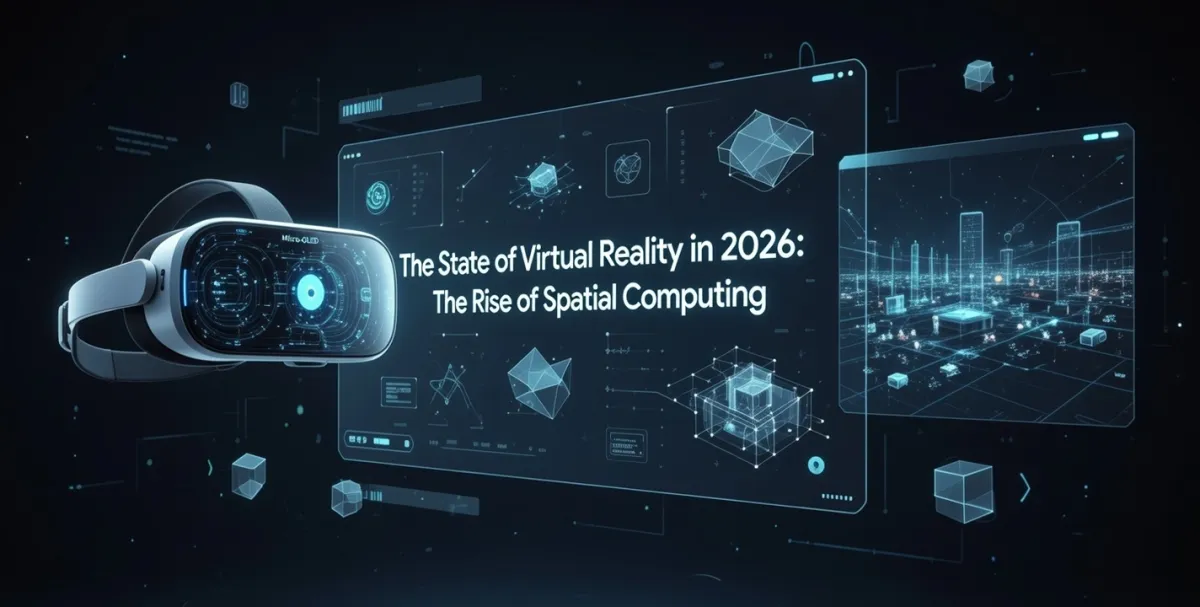
If you were to look back at the "Metaverse" hype of 2021, it felt like a fever dream of pixelated avatars and empty digital plots of land. Many skeptics labeled Virtual Reality (VR) a fading gimmick, destined to join 3D TVs in the graveyard of overhyped tech.
However, standing here in 2026, the narrative has shifted fundamentally. We no longer talk about "entering" the metaverse, we talk about Spatial Computing. The clunky, front-heavy headsets that caused neck strain and "screen-door effects" have been replaced by sleek, high-performance optics. VR is no longer just for gamers, it is the infrastructure for modern surgery, global engineering, and the next generation of social intimacy.
In this long-form exploration, we will break down the hardware, the software, and the profound societal shifts that have made VR an indispensable part of our daily lives.
1. Hardware: The Engineering Marvels of 2026
The most visible change in VR over the last few years is the hardware. The "brick-on-the-face" era ended with the mass adoption of Pancake Optics and Micro-OLED technology.
The Weight of Innovation
In 2022, a standard headset weighed between 500 and 700 grams. Today’s flagship devices from Apple, Meta, and Sony have hovered down to the 250-300 gram range. This was achieved by moving the processing units and batteries. Some high-end models now use a "puck" system a small, external compute unit that clips to your belt or sits in your pocket, connected by a single ultra-thin fiber-optic cable. This has allowed the goggles themselves to become as thin as a pair of oversized aviators.
Visual Fidelity and the 60 PPD Threshold
The "Holy Grail" of VR has always been matching the resolution of the human eye. In 2026, we have finally crossed the 60 Pixels Per Degree (PPD) threshold in consumer devices. At this density, the human eye cannot distinguish between a digital pixel and reality.
Combined with High Dynamic Range (HDR) peaks of 5,000 nits, the sun in a virtual world now actually feels "bright," and shadows have the deep, terrifying inkiness of a real cave. This level of fidelity is what finally made VR-based productivity possible you can now read 8pt font on a virtual spreadsheet for eight hours without a hint of eye strain.
The End of Motion Sickness
For years, "VR sickness" was the industry’s biggest hurdle. By 2026, this has been largely solved through two breakthroughs:
- Ultra-Low Latency Passthrough: Sensors now track movement and update the display in under 10 milliseconds, which is faster than the human brain can perceive a lag.
- Varifocal Lenses: Using liquid lenses or mechanical actuators, modern headsets can change focus just like the human eye. When you look at an object up close in VR, your eyes physically accommodate, eliminating the "vergence-accommodation conflict" that caused nausea in older models.
2. The Mixed Reality (MR) Revolution
Perhaps the biggest trend of 2026 is that Pure VR is now a niche. Most "VR" headsets are actually Mixed Reality devices.
Through high-definition color cameras, these devices "pass through" the real world to the user. This has transformed the headset from an isolation chamber into an enhancement tool.
- The Infinite Workspace: Professionals no longer use physical monitors. They put on a headset and "spawn" five 4K monitors in their physical room. You can grab a virtual window and "pin" it to your real kitchen wall while you cook.
- Co-Presence: When you call a friend, they don't appear in a box on a screen. Their "Holopresence" avatar sits on your actual couch. Using advanced AI, the headset scans their facial expressions and body language in real-time, making it feel like they are truly in the room with you.
👉 Fill Up Juniper With Your Cum
3. Artificial Intelligence: The Silent Engine
You cannot discuss VR in 2026 without discussing AI. If hardware is the body, AI is the nervous system.
Foveated Rendering and Neural Graphics
Running two 8K displays at 120Hz requires more power than a mobile chip can provide. To solve this, AI-driven Eye Tracking monitors exactly where your pupil is focused. The system only renders that tiny "foveal" spot in full detail, while the periphery is rendered at a lower resolution. AI then "upscales" the edges so you don't notice. This trick reduces the computational load by nearly 80%, allowing mobile headsets to produce graphics that rival a $4,000 gaming PC.
Generative Environments
The most transformative software leap has been Text-to-Space. Much like we used to generate images with prompts in 2023, we now generate entire worlds. A user can say, "Build me a Zen garden during a rainstorm with 19th-century Japanese architecture," and the AI will build the 3D geometry, textures, and physics in real-time. This has democratized content creation, you no longer need to be a 3D artist to build a home in the digital world.
4. VR in Industry: Beyond the Living Room
Healthcare and Life-Saving Simulations
In 2026, a surgeon rarely performs a complex operation without first "practicing" on a digital twin of the patient. Using high-res scans, the VR system creates an exact replica of the patient’s anatomy. The surgeon can feel the resistance of the tissue through Haptic Gloves and identify complications before the first incision is made in the real world.
Education: The "Time Machine" Effect
History is no longer a subject you read, it’s a place you visit. Students today don't just look at photos of the Moon landing, they stand on the lunar surface alongside Neil Armstrong. VR has proven to increase retention rates by up to 70% compared to traditional classroom learning because the brain encodes the experience as a "memory" rather than "information."
Remote Engineering and Digital Twins
Architects and engineers now walk through buildings before a single brick is laid. By using VR, they can spot structural flaws or aesthetic issues that would be invisible on a 2D blueprint. This has saved trillions in construction costs globally over the last three years.
5. The Competitive Landscape: The Big Three
The market in 2026 is defined by a fierce rivalry between three philosophies:
- Apple (The Premium Productivity Giant): Apple’s vision is "Spatial Computing." They avoid the word "VR" and focus on replacing the Mac. Their devices are the most expensive but offer the highest polish, focusing on eye-tracking interfaces and ecosystem synergy.
- Meta (The Social Playground): Meta remains the volume leader. Their "Quest" line is the "console" of the VR world. They focus on gaming, social fitness, and making the technology affordable for the average family.
- The AndroidXR Alliance (Samsung, Google, Sony): This is the open-source counter-weight. By creating a standardized operating system, they allow dozens of manufacturers to build specialized hardware, from industrial-grade helmets to lightweight media-consumption glasses.
6. Challenges: The Dark Side of Immersion
Despite the wonders, 2026 is also a year of reckoning for the ethical implications of VR.
The Privacy of the Gaze
In the era of smartphones, companies tracked what we "clicked." In 2026, they track what we look at. Since eye-tracking is necessary for the tech to work, companies now have data on exactly how long you looked at an advertisement, which colors catch your eye, and even your emotional state (via pupil dilation). Legislative battles over "Biometric Privacy" are currently the hottest topic in global politics.
The "Reality Fatigue"
Psychologists are seeing a rise in "Reality Fatigue" a condition where users find the physical world dull or "low-resolution" compared to their hyper-vibrant, curated virtual environments. Maintaining a balance between the digital and the biological has become a major mental health priority for the mid-2020s.
7. Conclusion: The Invisible Technology
The ultimate goal of any technology is to become invisible. In 2026, we are almost there. We are moving away from "wearing a computer" and toward "inhabiting a digital layer."
Virtual Reality has matured. It is no longer a toy for the elite or a escape for the lonely. It is a bridge. It bridges the gap between a doctor in London and a patient in a rural village, between a student in 2026 and the history of 1026, and between a father on a business trip and his children at home.