
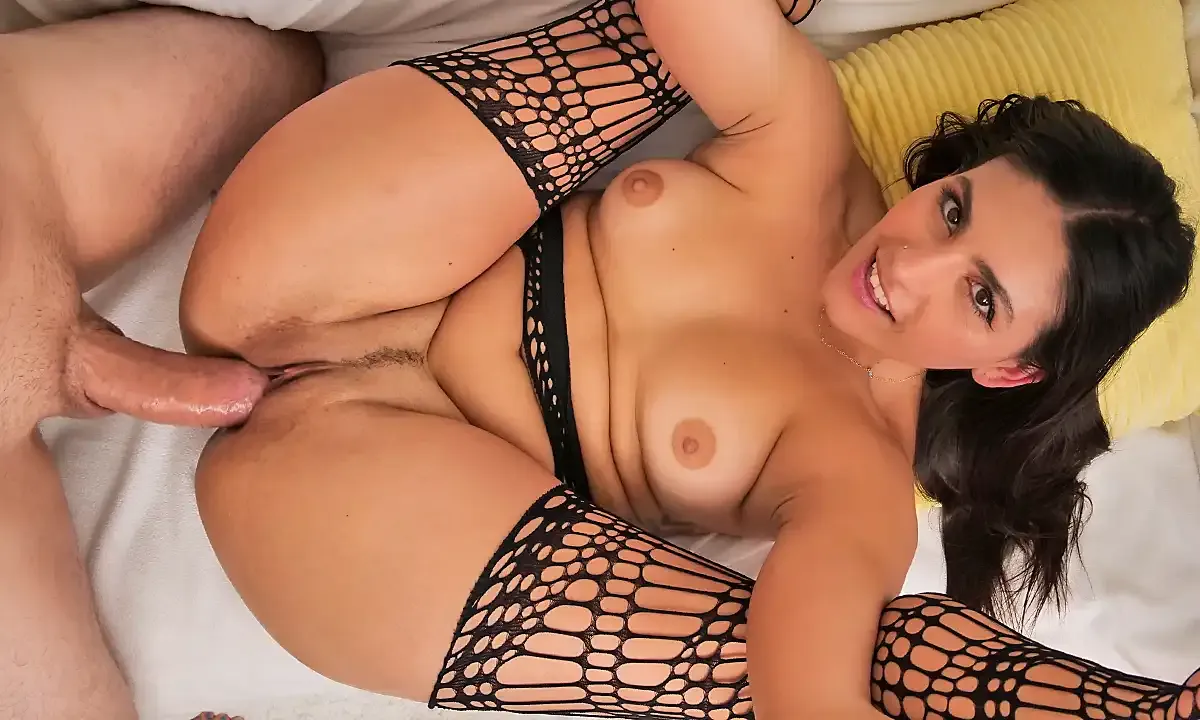
 Direct eye contact is where VR180 pulls ahead: true stereoscopic depth makes a performer feel present, not projected.
If you have browsed any VR adult library, you have seen both labels: VR180 and 360°. They sound like a simple numbers game, surely 360 is twice as good as 180?
In practice, it is almost the opposite. For filmed adult content, VR180 is the format most studios choose, most headsets play best, and most viewers describe as "more real." Here is why, explained without the marketing.
The short answer
VR180 films the half of the world in front of you, in stereoscopic 3D, two slightly different images, one for each eye. That is what gives you true depth: a performer feels close, at a real distance, at real scale.
360° films in every direction, including behind you. Most 360° adult video is monoscopic, one flat image wrapped around you. You can look everywhere, but nothing has real depth.
You trade freedom to look around for depth and sharpness. For adult content, depth and sharpness win almost every time.
1. Field of view: what you actually see
Your eyes do not see 360°. At any moment, your natural field of view is roughly 180-200 degrees, and your headset shows you even less. A Meta Quest 3, for example, displays about 110° horizontally.
A VR180 camera captures exactly the part you can face. Nothing is wasted behind you. A 360° camera spends half its pixels on the room behind your head, a wall, a door, a tripod shadow, that you will rarely turn around to look at, and that pulls you out of the scene when you do.
Think of it this way: a VR180 scene is a stage built for you. A 360° scene is a room you happen to be standing in. Stages are lit, framed and performed. Rooms are just there.
2. Sharpness: why 8K means more in VR180
Resolution in VR is about pixels per degree, not the headline number.
Take an 8K file. Spread it over 360°, and each eye gets a thin slice of those pixels. Concentrate the same 8K over 180°, and the image in front of you carries roughly double the detail per degree. Skin texture, eye contact and fine detail survive instead of softening, which is why serious studios shoot VR180 when they shoot in 8K.
This is also why a "360 4K" video can look worse than a "VR180 8K" video even on the same headset: the number on the label is not the number your eyes receive. When you compare two scenes, compare the format first and the resolution second.
 Close POV is the stress test for sharpness: concentrating 8K into 180° keeps near-camera detail intact.
3. Depth: stereo 3D vs a flat wrap
This is the biggest difference, and the hardest to show in a screenshot.
VR180 is stereoscopic. Two lenses film from positions roughly matching your eyes. Your brain reads the difference between the two images as distance. A hand reaching toward you actually approaches you, and a face leaning in gets genuinely closer, nearer than your headset, nearer than seems physically possible.
360° is usually monoscopic. One image, no difference between the eyes, no true distance. Performers can look like life-size cutouts in a photographed room, present, but not there.
True stereo 360° does exist, but the files are enormous, the stitching is prone to visible seams where the camera rigs join, and very little adult content is produced in it. When a scene is labelled simply "360," assume mono.
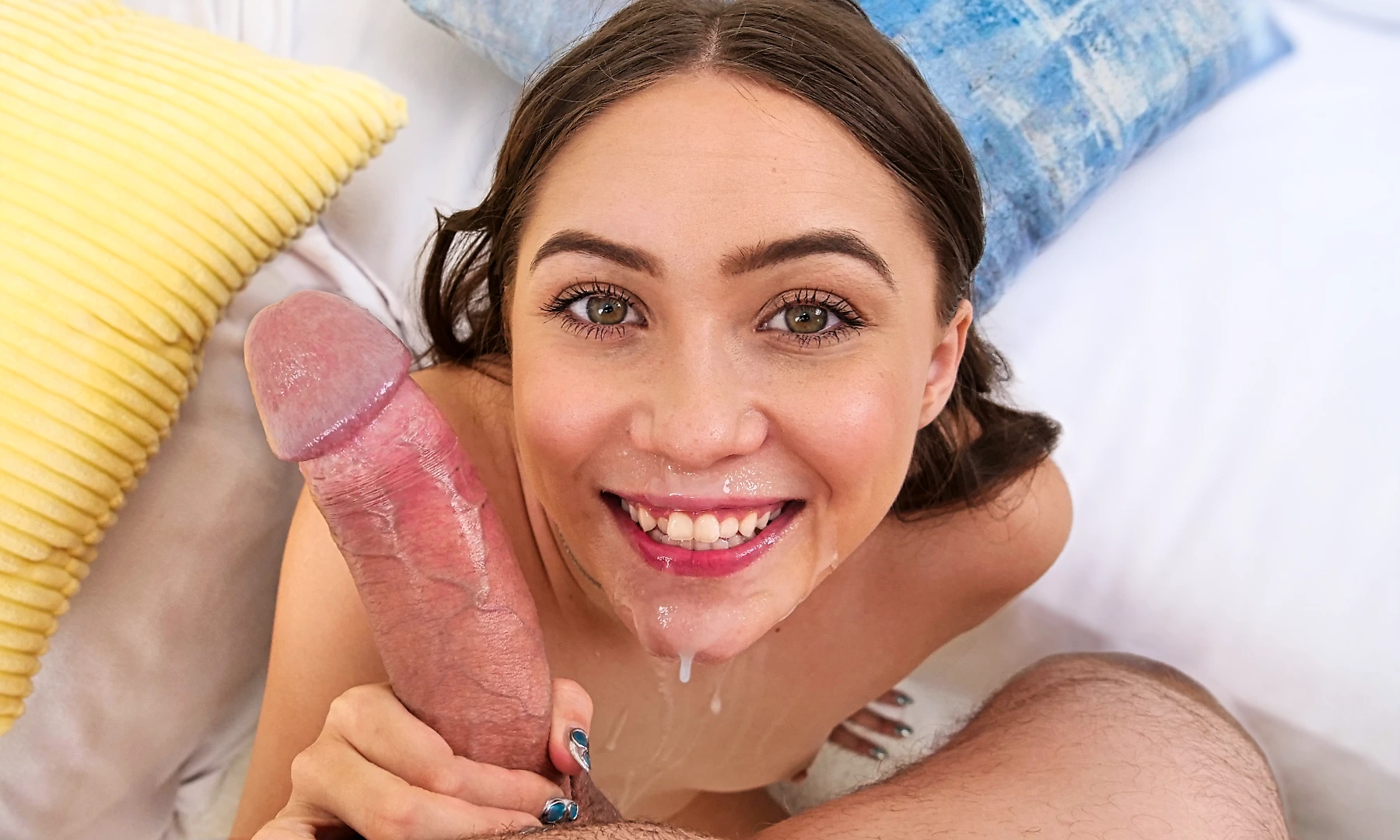 Stereo 3D is what your brain reads as distance, the core of the VR180 effect.
4. Comfort and directing
A VR180 scene is directed like a film: the action is framed, lit and performed for where you are sitting. You are the camera, and the scene is built around that. If the most important thing happening is a face six inches from yours, that is exactly where the director puts it.
In 360°, the crew cannot stand "behind the camera," because there is no behind. Lighting, microphones and crew have to hide inside the scene itself, and the action often drifts to wherever it fits. The result is more freedom to look around, and less control over what you are looking at.
VR180 is also easier on comfort. The world stays stable in front of you, which most viewers find less tiring over a full scene than constantly scanning a full sphere, and it keeps your attention where the performance actually is.
5. Where passthrough fits in
Passthrough, the mixed-reality format that places a performer in your room using the Quest 3's cameras, is built on the same logic as VR180: a stereoscopic subject, filmed for depth and scale, composited into your space. It only works because the subject was shot in true 3D. There is no practical mono-360 version of the effect.
That is another reason the industry's best-looking new format grew out of VR180, not 360°, and why our passthrough library assumes a VR180 pipeline from camera to headset.
VR180 vs 360° at a glance
| VR180360° | ||
| View | Everything in front of you | Every direction, including behind |
| 3D depth | Yes, stereoscopic | Usually no, monoscopic |
| Sharpness at 8K | High, pixels concentrated forward | Lower, pixels spread over a full sphere |
| File size / streaming | Smaller, streams more reliably | Larger for the same quality |
| Directing | Framed and performed for the viewer | Action placed wherever it fits the room |
| Best for | Filmed scenes, close-ups, passthrough | Environments, tours, looking around a space |
So which one should you choose?
Choose VR180 for filmed adult scenes, especially in 8K. More depth, more detail, better directing, and it is the format passthrough is built on.
Choose 360° only when the place is the point of the scene and you genuinely want to look around it, and accept the softer, flatter image as the trade.
That is why the DeepInSex library is built around 8K VR180 and passthrough: for this kind of content, "more degrees" is not the upgrade. More depth per degree is.
Frequently asked questions
Is VR180 actually 3D?
Yes. VR180 is shot with two lenses matched to the spacing of your eyes, so each eye receives a different image. Your brain combines them into real depth, the same principle as a 3D cinema film, wrapped into a headset.
Can I watch VR180 on a Meta Quest 3?
Yes. The Quest 3 plays VR180 natively in its browser and media players, and it is also the headset passthrough was designed for. No extra software is needed for standard VR180 files.
Why does 360° video look blurry on my headset?
Because the same resolution is spread twice as wide. A 4K 360° file gives you roughly the per-eye detail of a much lower-resolution VR180 file. If a 360° scene looks soft, the format, not your headset, is usually the reason.
Is stereo 360° better than VR180?
On paper it combines both, but in practice the files are far larger, stitching seams are hard to hide at close range, and very little adult content is produced in it. For close-up filmed scenes, VR180 remains the practical best quality.
New to either format? Start with our roundup of the hottest VR newcomers to watch in 2026, or browse the latest VR blog posts and scene guides to see the difference in current releases.
About the author. Written by the DeepInSex editorial team, who test VR playback across headsets and review new VR180 and passthrough releases weekly.
Experience True 8K Virtual Reality
Stream our master-grade 8K VR porn scenes in 180° POV and ultra-realistic passthrough on DeepInSex.