
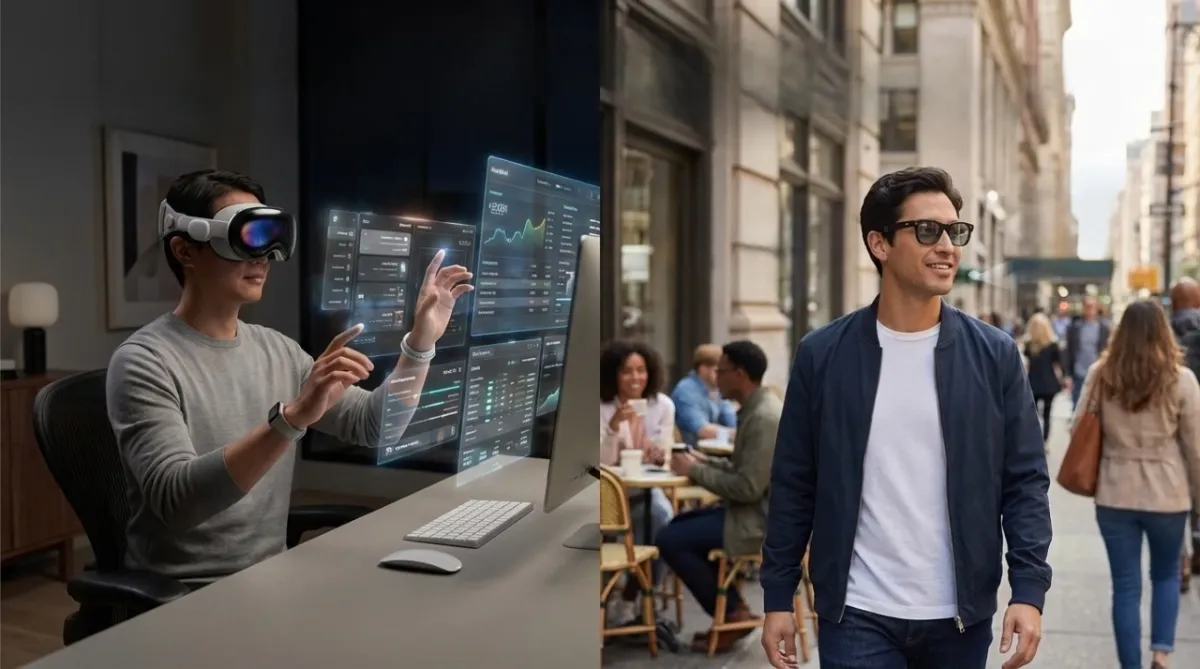
In early 2026, the tech industry finally stopped talking about "The Metaverse" as a singular destination and started talking about Spatial Presence as a spectrum. The smartphone, once the sun around which our digital lives orbited, has entered its twilight years. It is no longer the primary window to our world instead, it has become a "pocket-bound compute puck" a battery and processor that feeds information to the glass on our faces.
But as the screen died, a great schism emerged. We are no longer debating whether to wear computers on our faces we are debating which version of reality we want to inhabit. On one side, we have the Immersive Hardliners, who demand total visual replacement. On the other, the Augmented Minimalists, who demand that technology be felt, not seen.
Chapter 1: The Immersive Titans (The MR Powerhouse)
By 2026, Mixed Reality (MR) has matured into a professional necessity. Devices like the Apple Vision Air and Meta Quest 4 Pro have moved beyond the "enthusiast" phase and into the "Spatial Workstation" phase.
1.1. The Technical Architecture of 2026 Headsets
To understand why these devices are so large, one must understand the math of immersion. To trick the human eye into believing a digital object is real, you need a Pixel-Per-Degree (PPD) count of at least $60$. In 2026, high-end headsets have finally hit the $80\text{--}90$ PPD range.
- Pass-through Latency: The "Photon-to-Photon" latency has dropped below $8ms$. This means that when you move your hand in front of your face, the cameras capture it, the processor renders it, and the screens display it faster than your brain can detect a delay.
- The Varifocal Breakthrough: 2026 marked the widespread use of liquid lenses. These lenses physically change shape based on where your eyes are focusing (tracked by IR sensors), solving the "Vergence-Accommodation Conflict" that caused nausea in earlier VR models.
1.2. The New Office: A Zero-Gravity Desk
In the 2026 workplace, the physical desk is a relic. Professionals now work in "The Void" a customizable virtual environment.
- Infinite Canvas: Instead of two 27-inch monitors, a trader in 2026 has a 360-degree sphere of live data.
- Neural Typing: Using EMG (electromyography) wristbands, users can type by simply tapping their fingers on their thighs or a table. The headset interprets these micro-gestures as keystrokes, allowing for $120$ words per minute with zero physical hardware.
Chapter 2: The AR Minimalists (The Smartglass Revolution)
While the Titans were building "scuba masks of productivity," a quiet revolution was happening in the fashion industry. The Meta Ray-Ban Gen 4 and the Google Lens 2 have become the most popular wearable tech in history, precisely because they don't look like tech.
2.1. The Invisible UI
AR Smartglasses in 2026 do not use bulky cameras for pass-through. Instead, they use diffractive waveguides. Light is projected from a tiny laser in the temple of the glasses and bounced through microscopic gratings inside the glass itself.
- Display Style: These are not for watching movies. They are for Glanceable Data. A notification pops up in your peripheral vision, looking like a translucent hologram floating $2$ meters away.
- The AI Whisperer: The real power of 2026 smartglasses is the Multimodal AI. The glasses see what you see. If you are looking at a broken engine or a foreign plant, you don't "search" for it. You just ask, "How do I fix this?" and the AI whispers the instructions into your ear via bone-conduction speakers.
2.2. The Social Acceptance Factor: The "Coffee Shop Test"
The defining metric of 2026 is the Coffee Shop Test. If you can walk into a local café, order a drink, and have a conversation without the person behind the counter feeling uncomfortable, the device passes.
- Smartglasses: Pass with flying colors. They are indistinguishable from fashion eyewear.
- MR Headsets: Fail. They are still seen as "Deep Work" tools the digital equivalent of wearing noise-canceling headphones and a "Do Not Disturb" sign.
Chapter 3: The 6G & Cloud Edge Bridge
The reason 2026 is the "Year of the Split" is the rollout of 6G Connectivity.
3.1. Offloading the Brain
In 2024, headsets had to be heavy because they carried the battery and the processor. In 2026, we use Edge Compute. The heavy lifting is done by a small "puck" in your pocket or a server $5km$ away.
- Latency Math: With 6G, the round-trip time for a data packet is less than $1ms$.
- The Result: Smartglasses can stay light because they are essentially just "displays with batteries." The "brains" live in the cloud.
Chapter 4: The Economic Shift – The Death of Physical Goods
The "Great Split" has created a massive shift in how we spend money. In 2026, the "Home Theater" market has collapsed. Why buy a $3,000$ OLED TV when your $800$ headset can simulate a $500\text{-inch}$ IMAX screen in your bedroom?
4.1. Spatial Advertising
Advertisers in 2026 no longer buy billboards. They buy Spatial Anchors.
- If you are wearing AR glasses, a Starbucks may appear to have a golden glow, or a digital "daily special" menu may float above the door.
- This has led to the "Ad-Blocker War of 2026," where users pay premium subscriptions to keep their physical world free of digital clutter.
Chapter 5: The Psychological & Societal Impact
We cannot talk about 2026 without talking about Digital Presence vs. Physical Absence.
5.1. The "Presence" Paradox
Psychologists are seeing a rise in "Presence Fatigue." In 2026, you can be "present" at a birthday party in London while physically sitting in a chair in Singapore. While the visual fidelity is $99\%$, the lack of "haptic scent" and physical touch creates a strange emotional dissonance.
5.2. The Ethics of "Always-On" Cameras
Privacy has been redefined. In 2026, it is assumed that every pair of glasses in a room is recording. This has led to the "Consent LED" standard a mandatory, un-hackable bright purple light on all glasses that glows whenever the camera is active.
Chapter 6: The 2030 Outlook – The Convergence
Where is the Split taking us? By 2030, the two paths will likely merge.
- We are seeing early prototypes of Photochromic MR. These are glasses that look like Ray-Bans but can instantly turn pitch-black and opaque, switching from transparent AR to fully immersive VR in $0.1$ seconds.
Conclusion: Choosing Your Reality
The "Great Split" of 2026 is not about a winner and a loser. It is about Contextual Computing. We have realized that a human being is a multi-modal creature.
- We want to be augmented while we live.
- We want to be immersed while we work and play.
The smartphone era was a "flat" era. The 2026 era is "spatial." Whether you choose the power of the Headset or the elegance of the Glasses, one thing is certain: the world will never look the same again.