
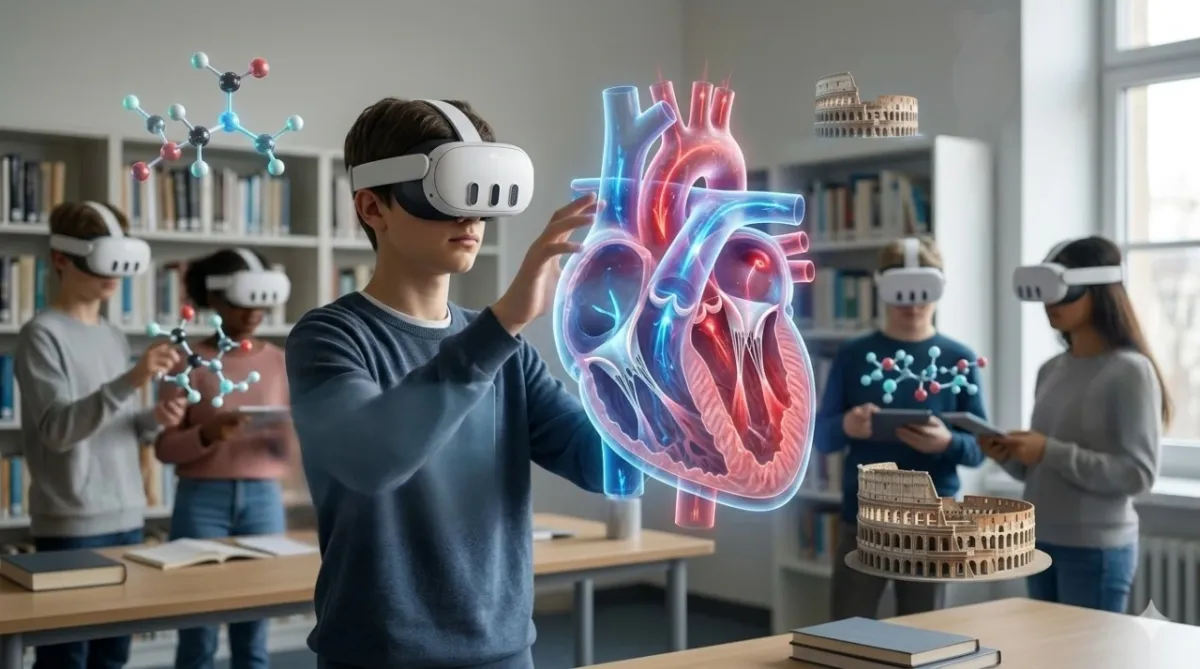
For over a century, the classroom remained static: a teacher, a chalkboard, and a 2D textbook. By 2026, the Meta Quest 3 has effectively shattered those walls. We are no longer asking students to read about the French Revolution or the internal structure of a cell, we are asking them to walk through them.
The shift to Spatial Learning, powered by high-fidelity Mixed Reality (MR) and Generative AI, is proving to be the most significant leap in pedagogical science since the invention of the printing press.
Chapter 1: History as a Destination, Not a Subject
In 2026, "History Class" is synonymous with "Time Travel."
1.1. AI-Powered Historical Reconstructions
Using the Quest 3’s processing power, schools now utilize apps that reconstruct ancient civilizations with photorealistic detail.
- Contextual NPCs: Students don't just look at ruins, they interact with AI-driven characters (Non-Player Characters) who speak the language and follow the customs of the era. You can ask a virtual Roman merchant about the price of grain, and the AI will respond using historically accurate data.
- Presence-Based Learning: Walking through a 1:1 scale model of the Library of Alexandria creates an "autobiographical memory" for the student. They aren't remembering a fact, they are remembering an experience.
Chapter 2: STEM and the Power of Spatial Visualization
Science, Technology, Engineering, and Math (STEM) subjects are notoriously difficult because they often require visualizing abstract, invisible forces.
2.1. The "Magic School Bus" Effect in Biology
With the Quest 3, biology students can "shrink" and enter the human bloodstream.
- Interactive Anatomy: Instead of a plastic model, students can use their hands to pull apart a virtual human heart, watching the valves pump in real-time.
- Molecular Chemistry: AI allows students to "grab" atoms and snap them together to form molecules. If the bond is unstable, the AI provides an immediate visual explosion and explains the chemical reasoning behind the failure.
2.2. Engineering in Mixed Reality
Engineering students now use Mixed Reality (MR) to overlay digital schematics onto physical objects.
- X-Ray Vision: Imagine looking at a real internal combustion engine through the Quest 3 and seeing a holographic overlay of the thermal stresses and fluid dynamics occurring inside while it runs.
Chapter 3: The Personalized AI Tutor
The most profound shift in 2026 is the integration of LLMs (Large Language Models) directly into the XR environment.
- The Infinite Patience of AI: Every student has a private tutor that lives within the headset. This AI monitors the student’s gaze and hand movements. If a student hesitates during a geometry problem, the AI subtly highlights the relevant angle or provides a spatial hint.
- Adaptive Difficulty: The AI curriculum scales in real-time. If a student masters the laws of physics in a virtual lunar simulation quickly, the AI might introduce "Jupiter gravity" to challenge their understanding of weight versus mass.
Chapter 4: Global Classrooms and Social Presence
The Quest 3 has solved the "isolation" problem of early distance learning.
- Virtual Field Trips: A school in rural Vietnam and a school in London can meet at the bottom of the Mariana Trench to study deep-sea bioluminescence. Students see each other as high-fidelity AI Avatars, allowing for body language and collaboration that a Zoom screen simply cannot replicate.
- Language Immersion: Instead of using flashcards, Spanish students spend 30 minutes a day in a virtual Madrid, ordering coffee and navigating streets where the AI only allows them to progress if they use correct grammar and pronunciation.
Chapter 5: Accessibility and the "Equalizer" Effect
In 2026, the Meta Quest 3 is viewed as a great equalizer in global education.
- Democratizing Labs: Many schools cannot afford expensive chemistry labs or specialized equipment. A $\$499$ headset provides access to a multi-million dollar virtual laboratory that never runs out of chemicals and cannot catch fire.
- Special Education: For students with ADHD or sensory sensitivities, the Quest 3 can create "focus environments" distraction-free zones where the visual field is simplified to help the brain process one piece of information at a time.
Conclusion: The Future is Spatial
The Meta Quest 3 is no longer a "gaming device" in the eyes of the public, it is the most powerful book ever written. By merging AI-driven intelligence with Spatial Presence, we have moved from an era of passive consumption to an era of active, immersive understanding.
The students of 2026 don't just learn about the world, they live in it.